It's easy to open an account
- Fill in our simple online application form
- Fund your account
- Start trading the global markets instantly!
definition
A forced open is a trading feature available on the Spreadex platform that instructs a new position to be opened without offsetting or closing any existing positions, even if the new position is in the opposite direction. Ordinarily, an opposite-side order would automatically reduce or close the current holding, but using a forced open ensures that the two positions coexist independently. This results in both a long and short position being open in the same market.
Whilst this feature can be useful, you should be aware that maintaining opposing positions may significantly increase your trading costs and operational complexity. Before using a forced open, you should ensure that you fully understand the additional charges, margin implications, and risks associated with managing two active positions.
Costs
Using the force open function requires you to maintain two independent positions, each of which carries its own transaction costs. This means that you will pay the spread twice, once for the long leg and once for the short leg, as well as any applicable overnight financing charges on both positions. Additionally, a short-borrow charge is still paid on the short position in any equities market of the force open. As a result, forced-open setups can increase overall trading costs compared with simply netting off or closing the existing position. You should weigh these additional costs before proceeding.
| | Netting Off | Forced Open |
|---|---|---|
| Spreads | Spread is only paid on one position, half when opening the trade and the other half when closing. | You will pay the spread twice, once on the long position and again on the short position. |
| Overnight Financing | A funding charge is only applied to the single directional position. This charge will reduce if you partially close your position as the overall notional value of the position falls. | Both positions accrue overnight financing charges independently, meaning the daily cost of holding a forced-open structure can be significantly higher than holding a single directional position. |
| Short Borrow Charge | Short borrow fees are only applicable if a short position is opened in an equities market. | Short borrow fees will still apply to the short leg of a forced-open in an equities market, even when the overall exposure is neutral. |
Margin Requirements
When opening opposing positions in the same market using a force open order, the margin requirement is determined solely on the position that carries the higher margin obligation, not the total of both.
Example
- Long position NTR: £10,000
- Force-opened short position NTR: £12,000
The total margin required for holding both positions would be £12,000, the larger of the two amounts.
Primary Uses
This mechanism is commonly used for hedging purposes, allowing you to manage short-term risk without altering your initial holdings, or for you to maintain separate strategies within the same market.
For instance, if you maintain a long-term long position in a market but anticipate a temporary decline in price, you can use the force-open function to establish a separate short position. This allows you to hedge against short-term downside risk without closing or amending your original long-term investment.
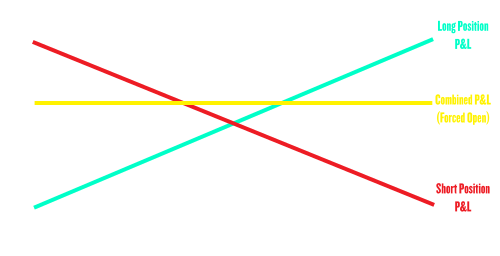
If you were to place two trades of the same size in opposite directions on the same market using a forced open, you would face a net zero exposure in the market.
Example
Suppose Company X is trading at 100 pence, and you open a £1pp long position. When the price rises to 110, this position shows a £10 unrealised profit. If you expect a short-term pullback in the share price, you can use a force-open order to initiate an equivalent £1pp short position at the current price of 110. This creates a neutral, or net-zero, market exposure. Due to the fact the long and short positions offset each other, you effectively ‘lock in’ the £10 P&L gain regardless of whether the share price subsequently rises or falls.
However, you must remember that both trades continue to incur ongoing trading costs, P&L remains fixed only for as long as both the opposing legs are of the same size and remain open, closing or changing the size of one side will immediately reintroduce market exposure to your overall position.


