Financial Trading Blog
Oil Spikes After US-Israel Attack on Iran
Markets open down as investors worry about the possibility of spillover, with gold and crude prices up after the US and Israel launch a prolonged military operation against Iran's leaders.
The Latest Developments
- Markets drop, and gold and crude surge amid a general risk-off move as markets face uncertainty at the start of a potentially prolonged US-Israel campaign against Iran.
- The Strait of Hormuz is closed, choking off around 20% of global crude supplies, while there have been attacks on refineries in the region, with OPEC increasing production in April by 206K boepd.
- The situation in Iran remains fluid without a clear successor to Supreme Leader Ali Khamenei, with contradicting statements from officials on talks.
- Markets fret over potential spillover as Iranian proxies attack the US and Israel from Lebanon and Iraq, while Iran launches missiles and drones against most countries in the Middle East with US assets, reaching as far as the UK's base in Cyprus.
Markets React to the Attack
As was anticipated, the US and Israel launched a coordinated air offensive against Iran on Saturday morning, local time, which was confirmed by US President Donald Trump posting a video to his social media platform. In his short speech, he said that the operation was ongoing and called for the people of Iran to seize the government. This immediately told the market that the current offensive was not like the pinpoint action of last June. Since then, Trump has said he expects the war to last as long as four weeks.
After a few hours on Saturday, Iran effectively closed the Strait of Hormuz, and ships off the coast of the UAE and Oman came under drone attacks. Iran launched missile and drone volleys towards countries in the Middle East, claiming to target US assets. Still, many of the projectiles landed far from US bases, and even Oman, which was helping to facilitate talks and has no US presence, was attacked by drones after allegedly helping US fighter jets to land. Hezbollah in Lebanon and Shiite militias in Iraq have attacked Israeli and US forces, with Israel responding by bombing the outskirts of Beirut, the first time since 2024. Houthi rebels in Yemen also vowed to renew attacks on Red Sea shipping.
Iran's response seemed disorganised and confused, and it was hours later that the nation confirmed initial strikes had killed Supreme Leader Ali Khamenei and many senior officials, including the President (who would be part of the transition council that took charge of the country). It is unclear who is in charge of Iran as of early Monday.
Trump on Sunday said he was still looking to do a deal with Iran that could lift sanctions, raising the potential of a TACO trade. Iran's Security Chief Ali Larijani, echoing Trump's language, said he hoped to resolve the situation through "pragmatic diplomacy". Larijani is seen as a potential successor to Khamenei. He was later quoted as saying, "We will not negotiate with the United States". This contrasts with earlier comments from Iran's Foreign Minister Abbas Araghchi, who called for a "return to dialogue and negotiations".
Brent prices jumped over $82 per barrel at the open, quickly falling back to $76 in the first few hours. Since then, however, crude has been trending higher. Gold also jumped to $5,365 at the open and has been climbing since, but it remains below $5,500. US futures and European stocks are in the red across the board, as investors shy away from risk, supporting the dollar.
On Sunday, OPEC+ agreed to boost oil production starting in April by 206K bbl per day, which helped ease the impact of the war on crude prices. However, through early Monday, there have been reports of attacks on refineries in the region, and several fields have been shut down as a precaution, constraining crude supplies in the short term.
Spillover and Market Evolution
Markets are bracing for uncertainty as the situation remains fluid. On Sunday, Iranian drones attempted to attack the UK's military base in Cyprus, with European Commission President Ursula von der Leyen calling for an emergency strategy meeting early Monday.
With the US distracted in Iran, discussions between Russia and Ukraine appear more difficult. Weekend reports suggest Russia could walk away from the negotiation table. China, the world's largest importer of crude and buyer of Iranian petroleum, has called for peace to prevent the spillover of fighting. However, a much-anticipated meeting between Trump and Xi seems to still be on the table for later this month.
Markets in risk-off mode will likely continue to support safe havens such as gold, while traders monitor developments in the Strait of Hormuz and the Red Sea. The dollar's initial bump suggests it remains a safe haven despite recent de-dollarisation trends.
Brent Breakout Opens Door to $100 if Neckline Holds
Despite the initial bump higher, Brent crude oil has failed to maintain the $80 handle as support, as momentum penetrated the overbought region. However, after forming a double bottom at $60, revisiting the neckline at around $80 might be an early sign of an imminent breakout. When double bottoms confirm, prices tend to extend the range from the breakout point, bringing the $100 level into focus. So if the round support or upper VWAP at $75 holds, Brent might extend toward triple digits. On the other hand, re-entering the VWAP territory might see prices revert to the median VWAP, suggesting a potential consolidation.
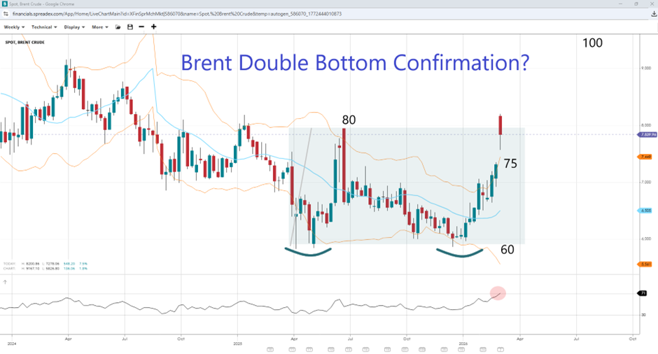
Source: SpreadEX | Spot, Brent Crude, Weekly Chart
It's easy to open an account
- Fill in our simple online application form
- Fund your account
- Start trading the global markets instantly!
SEARCH FOR AN ARTICLE:
Enter a keyword and search for all relevant articlesMARKET ANALYSIS
RECENT POSTS
DISCLAIMER
Spread bets and CFDs are complex instruments and come with a high risk of losing money rapidly due to leverage. 61% of retail investors lose money when trading spread bets and CFDs with this provider. You should consider whether you understand how spread bets and CFDs work and whether you can afford to take the high risk of losing your money. For professional clients, spread betting and CFD trading can also result in losses larger than your initial stake or deposit.
Spreadex Ltd is authorised and regulated by the Financial Conduct Authority, provides an execution only service and does not provide advice in any way. Nothing within this update should be deemed to constitute the provision of investment advice, recommendations, any other professional advice in any way, or a record of our trading prices. This update does not constitute or form part of an offer of, or solicitation for a transaction in any financial instrument, nor shall it or the fact of its distribution form the basis of, or be relied on in connection with, any contract therefore. Any persons placing trades based on their interpretation of the comments or information within this update does so entirely at their own risk.
No representation, warranty, or undertaking, express or limited, is given as to the accuracy or completeness of the information or opinions contained within this update by Spreadex Ltd or any of its employees and no liability is accepted by such persons for the accuracy or completeness of any such information or opinions. As such, no reliance may be placed for any purpose on the information and opinions contained within this update.
The information contained within this update is the intellectual property of Spreadex Ltd and is protected by UK and International copyright laws. All rights reserved. Users may however freely download, distribute and reproduce extracts of the contents, subject always to accrediting Spreadex Ltd as the source and providing a hyperlink to www.spreadex.com.


