Financial Trading Blog
UK CPI Amid Bets BOE Could Hike in April
After a hawkish hold by the BOE, markets are looking to February CPI data to get a baseline for how higher energy costs could affect the economy and the likelihood of an April rate hike.
The Key Data Points
- UK February CPI expected to remain unchanged, setting the baseline for potential impact from higher energy prices.
- Britain could see a smaller economic impact from the oil supply interruption but face similar inflationary pressures.
- Markets are wary of the government's ability to deal with higher prices, given its tight finances.
- Cable under pressure as markets price in up to two rate hikes this year if conditions in the Middle East persist.
Inflation Not Coming Down to Target
Even before the war in the Middle East started, UK CPI was above target. However, the BOE was on a dovish track, as consumer price growth was expected to fall later in the year amid deteriorating demand and growing slack in the labour market. The prospect of a supply shock in petroleum products means inflation might not come down to target, so the BOE will have to resume hiking. Last week's rate decision apparently surprised the market, as every MPC member voted to hold, signalling that even the most dovish members were concerned about the inflation implications. Following the BOE decision, the market priced in a 40% chance of a rate hike in April and over 50 bps of tightening by the end of the year. Before the war, energy prices were helping ease inflation, as they were lower than a year ago. Energy could now be the biggest contributor to CPI, depending on how long the war lasts and how much oil infrastructure is taken offline amid military strikes on either side of the Gulf.
If February inflation remains sticky, or even increases, it would mean that the BOE has little room to wait for the effects of higher energy prices to take hold. Rather than raise the odds of how much the BOE will tighten, it could shift the timing, increasing investor bets of an April hike. Given the negative impact the hike will have on the economy, the pound could weaken. On the other hand, if inflation is softer than anticipated, the BOE could hold off on hikes even if the energy crisis isn't resolved immediately. It may not change the total expected tightening, but it could delay it until later this year. That would stave off the immediate negative economic impact and leave open the possibility that the BOE might not have to hike as much. This could help support the pound. Headline UK CPI is expected to remain unchanged at 3.0%, while the core rate is predicted to also remain unchanged at 3.1%.
Cable Moves on the Dollar
This week, cable has fluctuated on the dollar amid shifting market sentiment. However, the UK is seen as being slightly better off in these circumstances. Unlike the EU, which imports over 90% of its oil, Britain's North Sea production means it imports around 50% of its needs. Still, the inflationary impact would likely be similar, as it is priced in Brent. What could cause additional concern for traders is that, even before the war broke out, government borrowing jumped by £14.3 billion in February, in part due to the timing of interest payments. This scenario constrains the government's finances and its ability to offer relief to consumers that could have mitigated some of the impact of higher crude prices. UK Chancellor Rachel Reeves is scheduled to present contingency plans to Parliament today, Tuesday. After that, the cable will likely move in line with the timing of expected rate hikes.
Cable Retests Upper VWAP Line
GBPUSD has peaked at the upper VWAP for now, shy of 1.35, with recent price action pointing to a potential sideways consolidation with the bottom near 1.3200. After bottoming out at 1.3216 following a momentum divergence, cable has risen, with a sustained move above the middle VWAP near 1.3350 supporting further upside while RSI stays above the 50 line.
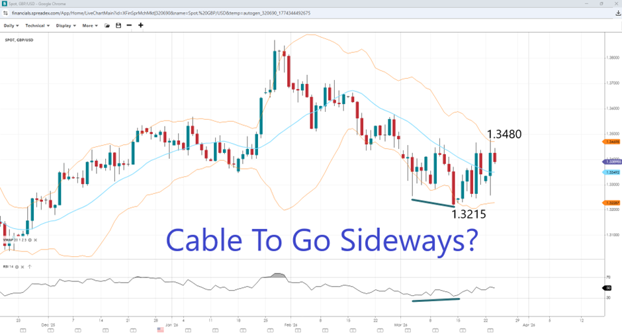
Source: SpreadEx | GBPUSD, Daily Chart
It's easy to open an account
- Fill in our simple online application form
- Fund your account
- Start trading the global markets instantly!
SEARCH FOR AN ARTICLE:
Enter a keyword and search for all relevant articlesMARKET ANALYSIS
RECENT POSTS
DISCLAIMER
Spread bets and CFDs are complex instruments and come with a high risk of losing money rapidly due to leverage. 61% of retail investors lose money when trading spread bets and CFDs with this provider. You should consider whether you understand how spread bets and CFDs work and whether you can afford to take the high risk of losing your money. For professional clients, spread betting and CFD trading can also result in losses larger than your initial stake or deposit.
Spreadex Ltd is authorised and regulated by the Financial Conduct Authority, provides an execution only service and does not provide advice in any way. Nothing within this update should be deemed to constitute the provision of investment advice, recommendations, any other professional advice in any way, or a record of our trading prices. This update does not constitute or form part of an offer of, or solicitation for a transaction in any financial instrument, nor shall it or the fact of its distribution form the basis of, or be relied on in connection with, any contract therefore. Any persons placing trades based on their interpretation of the comments or information within this update does so entirely at their own risk.
No representation, warranty, or undertaking, express or limited, is given as to the accuracy or completeness of the information or opinions contained within this update by Spreadex Ltd or any of its employees and no liability is accepted by such persons for the accuracy or completeness of any such information or opinions. As such, no reliance may be placed for any purpose on the information and opinions contained within this update.
The information contained within this update is the intellectual property of Spreadex Ltd and is protected by UK and International copyright laws. All rights reserved. Users may however freely download, distribute and reproduce extracts of the contents, subject always to accrediting Spreadex Ltd as the source and providing a hyperlink to www.spreadex.com.


