Financial Trading Blog
Are Software Stocks Near the Bottom?
Tech stocks bounce back from Monday's "AI Dystopia" selloff, leaving some analysts wondering whether software firms have touched bottom or if there is another leg lower to go.
The Latest Developments
- Tech stocks are recovering from a Monday sell-off provoked by a "thought experiment" of the impact of AI on the economy.
- A Citrini Research blog post hypothesised that AI agents could trigger an economic slowdown and a surge in unemployment in the coming years.
- NVIDIA posted another earnings beat, with sales rising 73% and helping reassure markets that there is still strong demand for AI hardware.
- Some analysts are pushing back on the notion that AI will displace third-party software companies, and most sector stocks are in oversold territory.
A Thought Experiment Crashes the Markets
Monday was a dour day for the markets, which were expected to open higher after the Supreme Court reduced uncertainty over the tariff situation. However, the Nasdaq ended the day 1.1% lower amid a broad-based tech selloff, leaving the tech-software sector down 5% for the day. Analysts pointed to a Citrini Research report outlining a hypothetical 2028 scenario in which accelerating AI capabilities trigger massive white-collar job cuts. The blog post struck a sensitive nerve in markets, hypothesising that agentic coding tools would displace SaaS products. AI agents could eliminate friction-based business models, suggesting that habitual brand loyalty could disappear as LLMs could comparison-shop every transaction. The piece concluded by suggesting a surge in unemployment among high-spending consumers, which could trigger a cascading effect across credit markets and the broader economy. DoorDash was cited as one of the most vulnerable, IBM shares dropped the most in 25 years, and even payment processors like Visa and Mastercard were down by over 4%.
After the drop, the article's author expressed shock that it had triggered a market sell-off, saying it was just a thought experiment and was intended to spark debate. And it just might have been a coincidence, with the note at most crystallising investor fears that have dragged down software-based tech stocks throughout this earnings season. Journalists might have just seized on the headline to explain the sudden reversal in market sentiment on Monday. But then the market switched direction again on Tuesday and had completely erased all the losses by Wednesday. On Tuesday, Anthropic released a host of new enterprise capabilities for Claude, a follow-up to its launch of plugins a month ago that provoked a software stock drop. Late on Wednesday, Nvidia earnings once again beat expectations, sending its share price up over 4% and supporting the overall tech market as investor concerns over AI eased. However, the divergence between hardware (semiconductors) and software services companies continued, suggesting mixed views about the tech sector overall.
Have the Fears Gone Too Far
Some analysts are pushing back on the market's fears that AI will displace software companies, arguing that open-source tools that let businesses build their own enterprise offerings have been available for years. Yet, third-party software has only expanded during that time. Jefferies noted that more than half of software stocks are in oversold territory, and the rebound after the Citrini report could suggest that the downward push, at least for now, might have run out of steam.
Nvidia Breaks Triple Bottom Neckline
Nvidia bulls attempted to break out above $200 per share, but the upper VWAP put the run on pause. Still, NVDA stock may have completed a triple bottom at $170, with prices above the ~$190 neckline keeping the bias to the upside. As long as prices trade above this support, short-term resistance lies at the record peak of $210. However, if bulls fail to hold the level in a deeper pullback, support below the middle VWAP at $185 sits back at the $170 bottom, as the VWAP flattens.
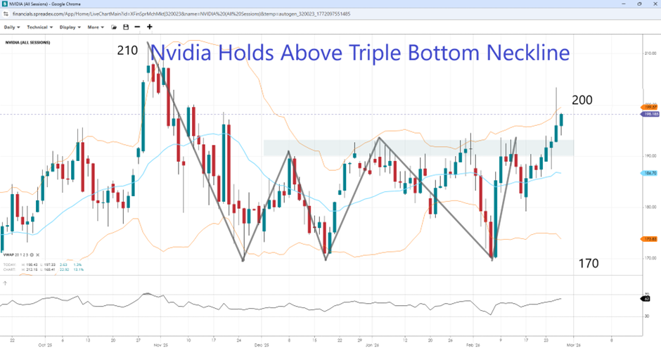
Source: SpreadEx | NVIDIA, Daily Chart
It's easy to open an account
- Fill in our simple online application form
- Fund your account
- Start trading the global markets instantly!
SEARCH FOR AN ARTICLE:
Enter a keyword and search for all relevant articlesMARKET ANALYSIS
RECENT POSTS
DISCLAIMER
Spread bets and CFDs are complex instruments and come with a high risk of losing money rapidly due to leverage. 61% of retail investors lose money when trading spread bets and CFDs with this provider. You should consider whether you understand how spread bets and CFDs work and whether you can afford to take the high risk of losing your money. For professional clients, spread betting and CFD trading can also result in losses larger than your initial stake or deposit.
Spreadex Ltd is authorised and regulated by the Financial Conduct Authority, provides an execution only service and does not provide advice in any way. Nothing within this update should be deemed to constitute the provision of investment advice, recommendations, any other professional advice in any way, or a record of our trading prices. This update does not constitute or form part of an offer of, or solicitation for a transaction in any financial instrument, nor shall it or the fact of its distribution form the basis of, or be relied on in connection with, any contract therefore. Any persons placing trades based on their interpretation of the comments or information within this update does so entirely at their own risk.
No representation, warranty, or undertaking, express or limited, is given as to the accuracy or completeness of the information or opinions contained within this update by Spreadex Ltd or any of its employees and no liability is accepted by such persons for the accuracy or completeness of any such information or opinions. As such, no reliance may be placed for any purpose on the information and opinions contained within this update.
The information contained within this update is the intellectual property of Spreadex Ltd and is protected by UK and International copyright laws. All rights reserved. Users may however freely download, distribute and reproduce extracts of the contents, subject always to accrediting Spreadex Ltd as the source and providing a hyperlink to www.spreadex.com.


