Financial Trading Blog
US DOJ Advances Breakup of Ticketmaster (Live Nation LYV)
Last Friday, the US Justice Department presented arguments in federal court seeking to break up the parent company of Ticketmaster, arguing that it engaged in monopolistic practices.
Key Points Affecting Markets
- Live Nation stock bounced after a New York federal judge declined to rule on the DOJ's suit to break up the company over antitrust concerns.
- Analysts express concern about the company's medium- to long-term outlook, given its high PE ratio.
- The company faces multiple regulatory hurdles, but analysts are more concerned about its sales growth outlook amid its $1.0 billion expansion programme.
Stock Rises After DOJ in Court
In the latest development among the multiple legal challenges that Live Nation is facing over its Ticketmaster unit, the DOJ made its case in federal court on Friday. This is separate from the FTC's suit over ticket resale tactics and a civil class action suit brought in 2022 in the wake of Taylor Swift's Eras Tour, which sparked controversy over excessive ticket prices for live events and led to government probes. The DOJ argues that Live Nation, which also manages artists and operates the largest live event ticketing portal, used its market position to "punish" venues that opted out of Ticketmaster in favour of rivals. The suit contends that the company, which owns over 265 concert venues and manages more than 400 artists, controls around 87% of the concert ticket market through Ticketmaster and 65% of the concert promotion market.
The company denies the allegations and asked on Friday for the judge to toss the lawsuit or to decide the case without a trial. Following the arguments, the judge did not rule on the company's request, which traders might have interpreted as a sign that the case might be settled without a trial, and the share price rose 6.5% after the court presentation. The company argues that the government has conducted investigations for years but has found only a few instances in which artists faced threats of having their concerns ignored or evidence of harm arising from the requirement to use Live Nation's promotional services.
Analysts Still Wary of the Stock
Live Nation merged with Ticketmaster back in 2010, but complaints about high ticket prices increased in the aftermath of the pandemic, leading to public backlash. Back in November of last year, the UK government banned ticket resales at prices above the posted price, which consumers accuse Ticketmaster of facilitating. After the stock price ran up through the first half of last year, peaking in early September, 13F filings showed several investors liquidating their positions in the company amid increasing legal challenges. Jefferies is the latest of six analysts to downgrade their outlook for the company, citing its high PE ratio and challenging growth prospects. Analysts believe the company's net profits will fall this year, after it increased its capital expenditure guidance to $1 billion last quarter. Notably, analysts don't believe the regulatory actions will affect the company's valuation; rather, they focus on the company's large investment plans, which won't yield a return for a couple of years.
Live Nation Faces Double Top Resistance
The bounce at around $140 per share, supported by the lower VWAP, has boosted prices to the opposite band at $150, suggesting a tight 10-dollar consolidation. The potential leading wedge pattern, which appears complete at the peak, however, suggests further upside. Wedges are typically followed by pullbacks (down to $140) before they eventually break out in the direction they point (up). If the pullback isn’t completed yet due to a flattening price action, the double top currently forming could send prices to the golden pocket at $135 if the bottom VWAP fails to hold bears. On the flip side, a higher breakout could set off a continuation of the uptrend towards $160, the 38.2% Fibonacci expansion of the $125-$150 leg.
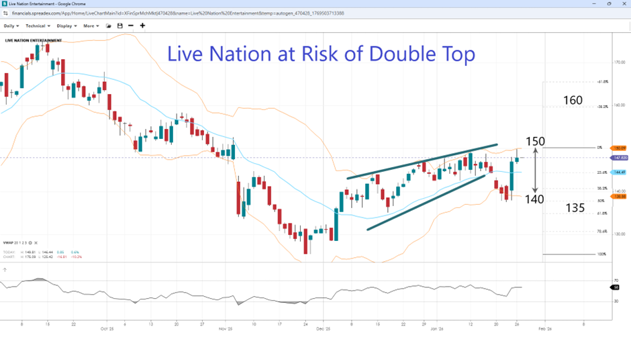
Source: SpreadEx | Live Nation Entertainment, Daily Chart
It's easy to open an account
- Fill in our simple online application form
- Fund your account
- Start trading the global markets instantly!
SEARCH FOR AN ARTICLE:
Enter a keyword and search for all relevant articlesMARKET ANALYSIS
RECENT POSTS
DISCLAIMER
Spread bets and CFDs are complex instruments and come with a high risk of losing money rapidly due to leverage. 61% of retail investors lose money when trading spread bets and CFDs with this provider. You should consider whether you understand how spread bets and CFDs work and whether you can afford to take the high risk of losing your money. For professional clients, spread betting and CFD trading can also result in losses larger than your initial stake or deposit.
Spreadex Ltd is authorised and regulated by the Financial Conduct Authority, provides an execution only service and does not provide advice in any way. Nothing within this update should be deemed to constitute the provision of investment advice, recommendations, any other professional advice in any way, or a record of our trading prices. This update does not constitute or form part of an offer of, or solicitation for a transaction in any financial instrument, nor shall it or the fact of its distribution form the basis of, or be relied on in connection with, any contract therefore. Any persons placing trades based on their interpretation of the comments or information within this update does so entirely at their own risk.
No representation, warranty, or undertaking, express or limited, is given as to the accuracy or completeness of the information or opinions contained within this update by Spreadex Ltd or any of its employees and no liability is accepted by such persons for the accuracy or completeness of any such information or opinions. As such, no reliance may be placed for any purpose on the information and opinions contained within this update.
The information contained within this update is the intellectual property of Spreadex Ltd and is protected by UK and International copyright laws. All rights reserved. Users may however freely download, distribute and reproduce extracts of the contents, subject always to accrediting Spreadex Ltd as the source and providing a hyperlink to www.spreadex.com.


