Spreadex Market Update
Mideast Crisis Weighs on Euro As Energy Prices Soar
Eurozone assets are under pressure as investors fear a prolonged war in the Middle East could raise energy costs in Europe and stifle already slow economic growth.
The Latest Developments
- The Eurozone is particularly vulnerable to an energy price shock due to the war in Iran.
- Russia is threatening to cut gas supplies to Europe amid tense peace talks over Ukraine.
- Markets are pricing in a supply-side inflation shock as shipments through the Strait of Hormuz are halted and freight companies reroute around Africa to avoid Red Sea.
- The euro is under pressure, as a more hawkish ECB outlook, combined with inflation, could weigh on the economy.
Eurozone Oil Dependency Sinks Euro
European assets are underperforming amid the war in Iran, with rising energy prices a top concern for investors on the continent and in the UK. European stocks have fluctuated in the opposite direction to oil prices, and the euro has lost 1% against the dollar amid safe-haven flows into the greenback. Europe is highly dependent on energy imports, and the issue was already highlighted by Russia's invasion of Ukraine. The EU has tried to wean itself off Russian imports over the last four years, becoming increasingly dependent on LNG imports from the US and the Middle East. Qatar was forced to shut its Ras Laffan LNG plant on Wednesday, taking 20% of global production off the market, and could stay offline for more than a month even if the Iran war ends quickly. Natural gas prices in Europe nearly doubled after the war started, reaching highs not seen in over a year despite particularly warm weather. While most of Europe's energy supply comes from the US, it is still reliant on Russia, and Saudi Arabia is the largest exporter of crude to EU refineries. Russian President Vladimir Putin on Wednesday threatened to halt gas supplies to Europe amid stalled peace talks over the war in Ukraine. Meanwhile, Saudi Arabia is shifting its oil export loading to its west coast, but Houthi rebels in Yemen have threatened to attack shipping in the Red Sea in solidarity with Iran. Major shippers are once again avoiding the Suez Canal and taking the much longer voyage around Africa, which could increase import costs and slow European trade with Asia.
Markets are printing in a supply-side inflation shock driven by shipping constraints through the Red Sea and rising energy costs. The US, a net exporter of petroleum, is seen as relatively immune, while Europe, Japan and South Korea are particularly vulnerable to price fluctuations in crude and natural gas. Reports circulated on Thursday that South Korea has gas reserves for only nine more days. The White House has announced measures to ease stress on the energy market, including mandating insurance coverage for the Strait of Hormuz and providing navy escorts. However, that doesn't cover the Red Sea, which is vital for European imports of not just energy but also trade with the Far East. Europe's reluctance or inability to secure its trade routes makes it particularly vulnerable to supply price shocks, as the US is engaged in a conflict with Iran.
Timing Is the Key To Recovery
The war has been going on for less than a week, and US President Donald Trump says he intends to wrap things up in less than a month. Energy storage levels in the EU are about 30%, which is in line with historic levels for this time of year, although below average. As long as the conflict in the Middle East is resolved quickly, Europe likely has enough energy coverage. But if shipping closures persist and Iran's energy production facilities suffer significant degradation, the Eurozone could face renewed inflationary pressure. Already, markets have moved to price out an ECB rate cut by the end of the year (previously at 50% odds). Higher interest rates and higher energy prices could weigh on economic growth, undermining investor demand in European equities and, by extension, the euro. By comparison, demand for US assets could put double downward pressure on the EURUSD the longer the war in the Middle East persists.
EURUSD Near Flag Bottom Ahead of NFP
EURUSD has also been heading lower ahead of the NFP later today, losing the 1.1600 handle and paving the way for 1.1560 and the early February low at 1.1530. Breaking below the flag-like correction would expose the measured-move projection at 1.1450, while a bounce at the lower bound could see 1.1600 reclaimed by the bulls. A weak NFP might push EURUSD back to the 1.1650 peak if the upper band at 1.1625 gives way, though it is unlikely to change the longer-term macro trajectory so long as the Middle East conflict continues.
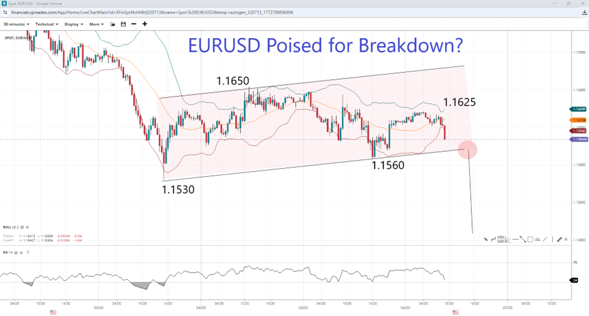
Source: SpreadEx | EURUSD, 30-mins Chart
It's easy to open an account
- Fill in our simple online application form
- Fund your account
- Start trading the global markets instantly!
SEARCH FOR AN ARTICLE:
Enter a keyword and search for all relevant articlesMARKET ANALYSIS
RECENT POSTS
DISCLAIMER
Spread bets and CFDs are complex instruments and come with a high risk of losing money rapidly due to leverage. 61% of retail investors lose money when trading spread bets and CFDs with this provider. You should consider whether you understand how spread bets and CFDs work and whether you can afford to take the high risk of losing your money. For professional clients, spread betting and CFD trading can also result in losses larger than your initial stake or deposit.
Spreadex Ltd is authorised and regulated by the Financial Conduct Authority, provides an execution only service and does not provide advice in any way. Nothing within this update should be deemed to constitute the provision of investment advice, recommendations, any other professional advice in any way, or a record of our trading prices. This update does not constitute or form part of an offer of, or solicitation for a transaction in any financial instrument, nor shall it or the fact of its distribution form the basis of, or be relied on in connection with, any contract therefore. Any persons placing trades based on their interpretation of the comments or information within this update does so entirely at their own risk.
No representation, warranty, or undertaking, express or limited, is given as to the accuracy or completeness of the information or opinions contained within this update by Spreadex Ltd or any of its employees and no liability is accepted by such persons for the accuracy or completeness of any such information or opinions. As such, no reliance may be placed for any purpose on the information and opinions contained within this update.
The information contained within this update is the intellectual property of Spreadex Ltd and is protected by UK and International copyright laws. All rights reserved. Users may however freely download, distribute and reproduce extracts of the contents, subject always to accrediting Spreadex Ltd as the source and providing a hyperlink to www.spreadex.com.


