Financial Trading Blog
UK 30-Year Gilt Yield Hits 27-Year High
UK long-term borrowing costs have hit levels last seen before the financial crisis. The 30-year gilt yield touched its highest since 1998, while 10-year gilts reached an 18-year high. The moves aren't isolated: yields are climbing together in the US, Japan and the eurozone as an escalating US-Iran standoff over the Strait of Hormuz revives inflation fears. UK stocks and the pound have both come under pressure as a result.
Latest Market Moves
- The 30-year gilt yield hit an intraday high of 5.89% on Tuesday, its highest level since 1998.
- The 10-year gilt yield touched 5.268% on Wednesday, an 18-year high.
- Brent crude climbed to $95.45 a barrel on Wednesday, a five-week high, having traded above $97 intraday.
- The US 10-year Treasury yield rose to 4.81% on Wednesday, its highest in nearly three years.
Gilts Lead a Global Bond Rout
Gilt yields have been climbing all week, and Wednesday brought no relief. The 30-year yield first broke through its 1998 high back in May and has now pushed even further into that territory, with little sign of reversing. The 10-year has followed a similar path, extending its losses through the week to reach its own multi-year extreme.
The immediate catalyst is oil. Two tankers were reportedly struck by projectiles in the Strait of Hormuz, escalating tensions between the US and Iran, and crude has climbed steadily through the week as a result. Traders are now weighing the risk of oil pushing towards $100 if the situation deteriorates further. Higher energy prices feed directly into inflation expectations, which is exactly what long-dated bond markets are pricing in.
UK equities have felt the pressure too, if less severely than bonds. The FTSE 100 closed down 0.3% at 10,789.28 on Tuesday and was down a further 0.3% at around 10,757 in Wednesday trading, while the more domestically-focused FTSE 250 dropped 1.7% to 24,521.29 on Tuesday. The pound also softened on Tuesday, slipping to $1.3527 against the dollar and €1.1669 against the euro.
Higher gilt yields tend to hit rate-sensitive and domestically-focused sectors hardest, which explains the FTSE 250's larger fall. Housebuilders and precious metals miners were both under pressure as yields climbed, while energy stocks bucked the trend: BP and Shell both gained on Tuesday and Wednesday as crude prices rallied.
A Global Bond Story, Not Just a UK One
This week's gilt moves fit a pattern playing out across every major bond market. Japan's 10-year government bond yield reached 3% for the first time since 1996, a level one strategist described as a 'genuine regime change' after decades of JGBs anchoring global fixed income. Japan's 5-year yield hit a record 2.26%.
The rise isn't confined to the UK, Japan and the US either. Germany's 10-year bund yield rose to 3.35% this week, its highest since 2011, and France's 10-year yield touched 4.21%, a level last seen in 2008. The US Treasury curve has moved further out too, with the 30-year yield reaching 5.25% on Tuesday.
The drivers overlap but aren't identical. In Europe and the UK, the bigger factor is inflation expectations: eurozone inflation came in above 3% in August, keeping the European Central Bank on alert. In the US, the move has been more about rising real yields, with new Fed chair Kevin Warsh striking a hawkish tone on inflation even before the latest Middle East escalation.
Underneath it all sits a fiscal story that predates this week: deficits remain wide across the US, UK and Japan, and none of the major economies have done much to consolidate them. Heavy corporate bond issuance, particularly from tech companies funding AI spending, has added further supply to markets already digesting record government borrowing.
UK Long Gilt: Downtrend Resumes
UK Long Gilt is turning bearish again after a two-month corrective bounce, with this week's break below the rising trendline signalling the broader downtrend is reasserting itself. Price is slipping back below VWAP, and RSI in the mid-30s reflects building downside momentum without yet being oversold. A move back above the trendline would suggest the correction has more to run, but sustained losses through VWAP favour a retest of the year's lows.
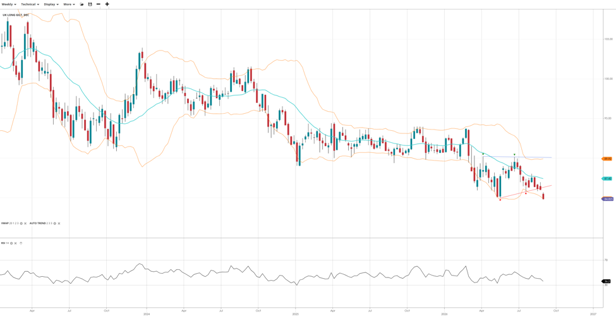
Source: SpreadEx | UK Long Gilt, Weekly Chart
It's easy to open an account
- Fill in our simple online application form
- Fund your account
- Start trading the global markets instantly!
SEARCH FOR AN ARTICLE:
Enter a keyword and search for all relevant articlesMARKET ANALYSIS
RECENT POSTS
DISCLAIMER
Spread bets and CFDs are complex instruments and come with a high risk of losing money rapidly due to leverage. 61% of retail investors lose money when trading spread bets and CFDs with this provider. You should consider whether you understand how spread bets and CFDs work and whether you can afford to take the high risk of losing your money. For professional clients, spread betting and CFD trading can also result in losses larger than your initial stake or deposit.
Spreadex Ltd is authorised and regulated by the Financial Conduct Authority, provides an execution only service and does not provide advice in any way. Nothing within this update should be deemed to constitute the provision of investment advice, recommendations, any other professional advice in any way, or a record of our trading prices. This update does not constitute or form part of an offer of, or solicitation for a transaction in any financial instrument, nor shall it or the fact of its distribution form the basis of, or be relied on in connection with, any contract therefore. Any persons placing trades based on their interpretation of the comments or information within this update does so entirely at their own risk.
No representation, warranty, or undertaking, express or limited, is given as to the accuracy or completeness of the information or opinions contained within this update by Spreadex Ltd or any of its employees and no liability is accepted by such persons for the accuracy or completeness of any such information or opinions. As such, no reliance may be placed for any purpose on the information and opinions contained within this update.
The information contained within this update is the intellectual property of Spreadex Ltd and is protected by UK and International copyright laws. All rights reserved. Users may however freely download, distribute and reproduce extracts of the contents, subject always to accrediting Spreadex Ltd as the source and providing a hyperlink to www.spreadex.com.


