Financial Trading Blog
Yen Rallies as BoJ Rate-Hike Bets Build
The yen has extended its rally against the dollar this week, with USD/JPY sliding from a high above 160 to trade near 157 as bets on a Bank of Japan rate hike build.
The move follows a meeting between US Treasury Secretary Scott Bessent and BoJ Governor Kazuo Ueda at the G20 finance meeting in North Carolina, where Bessent pushed Tokyo to take ‘decisive’ steps to address the yen’s weakness. It comes a month after the US and Japan carried out their first joint currency intervention since 1998, when the pair approached 164.
Latest Market Moves
- USD/JPY fell to around 156.80 during Thursday trading, extending its slide from Wednesday’s high of 160.39.
- EUR/JPY slipped to around 181.80, its weakest level since early August, as the yen’s strength broadened beyond the dollar.
- The Nikkei 225 was down 0.2% at 64,214 on Thursday, with yen strength weighing on exporters even as the wider market held up.
- The US 10-year Treasury yield touched 4.81% on Wednesday, its highest in nearly three years, keeping the yield gap with Japan wide even as BoJ hike bets build.
BoJ Hike Bets Build After Ueda’s Hawkish Turn
Tuesday’s comments were specific enough for markets to act on.
Ueda said the BoJ will debate raising interest rates ‘including in September’, focusing on whether inflationary risks are heightening enough to justify tightening, and swaps now fully price a quarter-point hike at the bank’s September 18 meeting. MUFG’s Lee Hardman called the yen ‘one of the biggest movers overnight.’ Board member Hajime Takata added that 2026 represents ‘a regime change’ in which hikes will no longer come at a fixed pace.
Friday’s US non-farm payrolls report, forecast at 58,000 jobs, is the next major catalyst for the pair.
Ueda’s comments followed a meeting with Bessent on the sidelines of the G20 finance ministers’ meeting in Asheville, North Carolina, on Tuesday. Bessent told reporters Tokyo needed to ‘do the right thing’ to address yen weakness, and a Treasury statement said he ‘expressed strong support for Japan’s decisive market and monetary steps to address the substantial undervaluation of the yen’, language that echoes the run-up to the two countries’ joint intervention a month earlier. He added that recent yen moves have been ‘not disorderly’ so far.
A Month On From the First Joint Intervention Since 1998
In late July, USD/JPY approached 164, its weakest level for the yen in roughly 40 years, prompting Japan’s Ministry of Finance to buy yen in coordination with the US Treasury for the first joint intervention by the two countries since 1998.
The pair fell to an intraday low near 155.20 before settling closer to 156.70. Finance Minister Satsuki Katayama and Bessent both said they were ready to act again if needed, and the BoJ had already raised rates to a 31-year high of 1% in June. The yen stayed under pressure through most of August regardless: Hardman noted it ‘remained under selling pressure over the past month, undermined by the ongoing negative energy price shock for Japan.’
USD/JPY: Testing the Rising Trendline
USD/JPY is now testing the rising trendline it had followed higher from April’s low, with this week’s slide also pulling price back under VWAP near 159.67.
The pair has been rejected three times near the 160-163 region since 2023, and RSI has dropped sharply from overbought territory to 44.8, mirroring the momentum loss seen at the previous two rejections. A close back above VWAP would suggest the move lower is corrective, but a weekly close below the trendline would open the door to a deeper pullback toward 155.75.
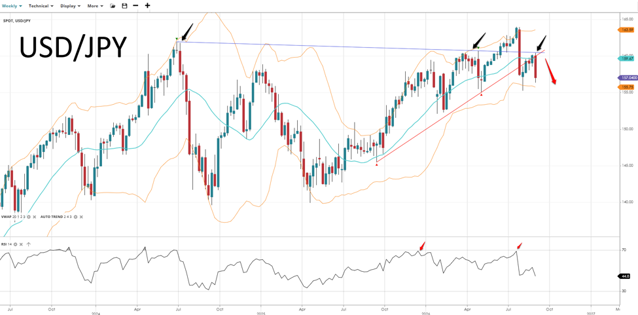
Source: SpreadEx | USD/JPY, Weekly Chart
It's easy to open an account
- Fill in our simple online application form
- Fund your account
- Start trading the global markets instantly!
SEARCH FOR AN ARTICLE:
Enter a keyword and search for all relevant articlesMARKET ANALYSIS
RECENT POSTS
DISCLAIMER
Spread bets and CFDs are complex instruments and come with a high risk of losing money rapidly due to leverage. 61% of retail investors lose money when trading spread bets and CFDs with this provider. You should consider whether you understand how spread bets and CFDs work and whether you can afford to take the high risk of losing your money. For professional clients, spread betting and CFD trading can also result in losses larger than your initial stake or deposit.
Spreadex Ltd is authorised and regulated by the Financial Conduct Authority, provides an execution only service and does not provide advice in any way. Nothing within this update should be deemed to constitute the provision of investment advice, recommendations, any other professional advice in any way, or a record of our trading prices. This update does not constitute or form part of an offer of, or solicitation for a transaction in any financial instrument, nor shall it or the fact of its distribution form the basis of, or be relied on in connection with, any contract therefore. Any persons placing trades based on their interpretation of the comments or information within this update does so entirely at their own risk.
No representation, warranty, or undertaking, express or limited, is given as to the accuracy or completeness of the information or opinions contained within this update by Spreadex Ltd or any of its employees and no liability is accepted by such persons for the accuracy or completeness of any such information or opinions. As such, no reliance may be placed for any purpose on the information and opinions contained within this update.
The information contained within this update is the intellectual property of Spreadex Ltd and is protected by UK and International copyright laws. All rights reserved. Users may however freely download, distribute and reproduce extracts of the contents, subject always to accrediting Spreadex Ltd as the source and providing a hyperlink to www.spreadex.com.


