Financial Trading Blog
Mag7 Earnings Fail To Lift Tech Stocks
After most of the "Magnificent 7" tech stocks have reported this season, the tech sell-off continues as investors fret over AI disruption and turn to value assets.
The Latest Developments
- The tech space remains volatile after most of the Magnificent 7 stocks report earnings and increase their AI spending.
- Traders worry about the AI impact on software companies, but some suggest that the sell-off has run its course as markets look past earnings and focus on upcoming data that could be pivotal for monetary policy.
- Google earnings show the company is gaining ground in the AI space, but increased capex is punishing the stock, a sign that investors are looking for an ROI.
AI Gains as Software Declines
It has been a rough week for the software development companies, with the software and services index falling almost 5% between Tuesday and Wednesday. The broad selloff came as traders assessed whether developments in AI would allow companies to use LLMs to develop their own software tools. The latest disruption came from Anthropic's Claude, with a new tool that would mean the agent could perform legal tasks. Analysts interpreted this decrease as an indication that AI companies are venturing into the enterprise software sector, potentially disrupting firms that offer legal, financial, and coding services. Analysts suggest that the sell-off this week is just the latest leg of a trend that began last quarter and that the software and services index has fallen 26% since its peak in October.
While software companies have declined, businesses servicing the AI rollouts have continued to outperform as tech companies like Meta boost their capital expenditures. Fabs report that their AI chips are sold out and are struggling to meet demand. Google's parent company, Alphabet, reported earnings on Wednesday that surprised the market. The search engine giant was once seen as lagging in the AI race, prompting a return of the founders to kick-start LLM development. But Alphabet is finally catching up, with analysts noting that the company's Gemini 3 launch last quarter helped expand its enterprise and consumer market share. However, investors were a bit put off after the company announced an increase in capital expenditures to expand its AI footprint, and shares fell 1% in after-hours trading. Meanwhile, SpaceX acquired xAI as Elon Musk merged his two leading companies to expand AI capabilities amid a drive to consolidate the space. Rumours continue to persist that Musk is looking to acquire OpenAI.
Enough to Support the Nasdaq Now?
After the Nasdaq fell 1.5% on Wednesday, some traders are now speculating that the sell-off has run its course, at least for now, allowing Nasdaq futures to be marginally in the green. With most major tech stocks already reported, the bad news about software disruption and high memory costs might be in the rearview mirror. However, a risk-heavy calendar and continued signs of turbulence could pose an obstacle for the tech-heavy Nasdaq, as investors will have to wait until next week to get the latest jobs data and inflation numbers. The recent rebound in gold, while silver and bitcoin sell off, suggests investors are still inclined toward safe havens and might wait until Nvidia's earnings at the end of the month to make a fuller assessment of AI market dynamics.
Nasdaq Double Top Weighs on Price
After failing to hit prior record highs, Nasdaq’s drop from 26,210 has left behind a double-top formation, with the 25k handle offering support. With RSI below 50 but above 30, there is room for further declines towards 24,650 and the late-November trough of 23,850 that retested 24k. Given that it is the lowest level of the entire structure since record highs, it could offer a bounce. In the short term, however, if 24,650 turns into a local bottom and 25k holds the line, upside levels towards 26k sit at the daily opens of 25,320 and 25,840.
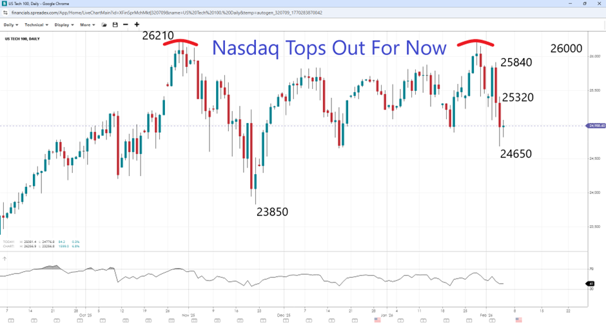
Source: SpreadEx | US Tech, Daily Chart
It's easy to open an account
- Fill in our simple online application form
- Fund your account
- Start trading the global markets instantly!
SEARCH FOR AN ARTICLE:
Enter a keyword and search for all relevant articlesMARKET ANALYSIS
RECENT POSTS
DISCLAIMER
Spread bets and CFDs are complex instruments and come with a high risk of losing money rapidly due to leverage. 61% of retail investors lose money when trading spread bets and CFDs with this provider. You should consider whether you understand how spread bets and CFDs work and whether you can afford to take the high risk of losing your money. For professional clients, spread betting and CFD trading can also result in losses larger than your initial stake or deposit.
Spreadex Ltd is authorised and regulated by the Financial Conduct Authority, provides an execution only service and does not provide advice in any way. Nothing within this update should be deemed to constitute the provision of investment advice, recommendations, any other professional advice in any way, or a record of our trading prices. This update does not constitute or form part of an offer of, or solicitation for a transaction in any financial instrument, nor shall it or the fact of its distribution form the basis of, or be relied on in connection with, any contract therefore. Any persons placing trades based on their interpretation of the comments or information within this update does so entirely at their own risk.
No representation, warranty, or undertaking, express or limited, is given as to the accuracy or completeness of the information or opinions contained within this update by Spreadex Ltd or any of its employees and no liability is accepted by such persons for the accuracy or completeness of any such information or opinions. As such, no reliance may be placed for any purpose on the information and opinions contained within this update.
The information contained within this update is the intellectual property of Spreadex Ltd and is protected by UK and International copyright laws. All rights reserved. Users may however freely download, distribute and reproduce extracts of the contents, subject always to accrediting Spreadex Ltd as the source and providing a hyperlink to www.spreadex.com.


