Financial Trading Blog
Brazil Stocks Break Out on Election Shock
Brazilian assets staged their biggest rally in more than six years this week after right-wing senator Flávio Bolsonaro edged ahead of President Lula in the first round of the presidential election.
Investors are expecting a more market-friendly, US-aligned government that takes a tougher line on spending. The move has pushed the MSCI Brazil ETF through a downtrend line that has capped it for more than a decade, although the 25 October runoff still has to be won.
Latest Market Moves
The MSCI Brazil ETF surged 12.6% on Monday, its biggest one-day gain since 2020, and held around 4,300 at Tuesday's close, the highest level since early 2020.
The Ibovespa jumped 7.7% on Monday to a record 206,912, its first close above 200,000.
USD/BRL fell more than 4% on Monday as the real broke through 5.00 per dollar, and the pair held around 4.98 in Tuesday trade.
Bank stocks led the charge in New York, with Bradesco ADRs up 18.5% and Itaú Unibanco ADRs up 15.4% on Monday, while Petrobras ADRs gained 11.6%.
Bolsonaro Takes Pole Position for the Runoff
Sunday's result upended pre-election polling that had Lula narrowly in front.
Flávio Bolsonaro, the 45-year-old son of former president Jair Bolsonaro, took 47.0% of the vote against 45.2% for the 80-year-old incumbent, sending the pair to a runoff on 25 October. No candidate who finished second in the first round has gone on to win the presidency since Brazil's return to direct elections in 1989.
His Liberal Party also won the largest blocs in both houses of Congress, with 28 Senate seats and 121 in the Chamber of Deputies. "Brazil wants change, and I am very happy with the results," Bolsonaro said, hailing "the end of the era" of Lula's Workers' Party.
What a Bolsonaro Presidency Could Mean
The market's enthusiasm rests on a platform built around a smaller state and a tighter grip on the public finances.
Bolsonaro's economic team, led by former mines and energy minister Adolfo Sachsida, has proposed a new fiscal anchor tied to the public debt trajectory, cutting the number of ministries from 39 to 23 and scrapping more than 20,000 political appointments. The plan also includes resuming privatisations on a case-by-case basis, revising Lula's tax reform to lower VAT, phasing out the IOF tax on financial transactions and revoking the 12% tax on crude oil exports.
On foreign policy, Bolsonaro is pitching closer ties with Washington, which matters given a 25% US tariff on most Brazilian goods has applied since July. He had asked the Trump administration to delay those tariffs until after the election, warning they "would hand the current Brazilian government precisely the political victory it has been engineering."
Banks and Petrobras Lead the Charge
The biggest winners were the heavyweight names that dominate Brazil's index, particularly those exposed to domestic interest rates and state influence.
Banks rallied hardest on hopes that a firmer fiscal stance will bring down borrowing costs, with state-controlled Banco do Brasil jumping as much as 13% in São Paulo on Monday alongside the surge in Itaú Unibanco and Bradesco. Petrobras shares closed 8.2% higher, with investors pricing in less political interference at the state oil major and the proposed removal of the crude export tax.
Not everything rose, though, as the stronger real weighed on exporters such as Suzano, Embraer and WEG, while miner Vale lagged with a gain of around 3%. Tuesday brought some giveback, with Banco do Brasil sliding 6.4% and Itaú Unibanco easing 1%.
Brazil's Economic Headaches Won't Vanish Overnight
Whoever wins on 25 October will inherit a difficult set of numbers.
Brazil's nominal budget deficit has approached 10% of GDP, driven largely by an interest bill running at around 8.5% of GDP, while gross public debt reached 82.9% of GDP in August, the highest in five years.
Any honeymoon period for Bolsonaro could end shortly though since he has yet to put numbers on its savings and tax cuts could widen the deficit before spending restraint kicks in, and an early push for an amnesty for his imprisoned father risks eating up political capital.
MSCI Brazil ETF Breaks a Decade-Long Downtrend
The monthly chart shows the MSCI Brazil ETF breaking decisively above a descending trendline that has run from its 2012 to 2013 highs.
That line capped the 2018 and 2020 peaks around 4,800 and turned the ETF back again in April this year, while a rising support line from the 2016 lows has held every major decline since, including the late-2024 sell-off. This week's jump has carried the price through the upper boundary near 3,900, leaving it up around 35% this year.
The breakout still needs a monthly close above the trendline to confirm it, and October's candle closes just days after the runoff, so the vote result is likely to decide the matter.
The 2018 and 2020 peaks near 4,800 are the next major resistance, while a slide back below 3,900 would put the September lows around 3,600 back in focus, with the monthly RSI at 67 showing strong but not yet stretched momentum.
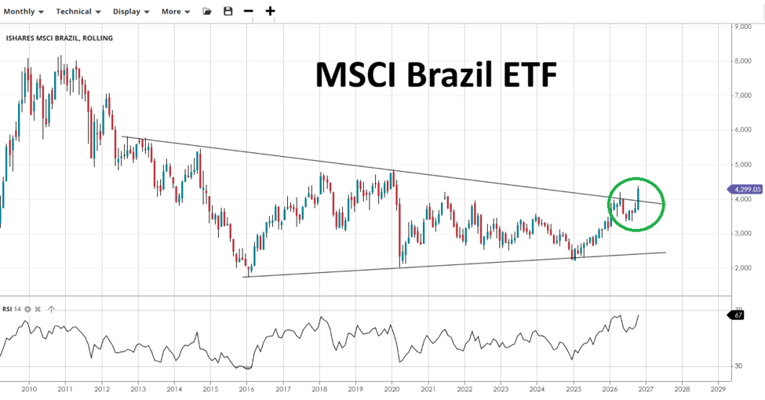
Source: SpreadEx | MSCI Brazil ETF, Monthly Chart
It's easy to open an account
- Fill in our simple online application form
- Fund your account
- Start trading the global markets instantly!
SEARCH FOR AN ARTICLE:
Enter a keyword and search for all relevant articlesMARKET ANALYSIS
RECENT POSTS
DISCLAIMER
Spread bets and CFDs are complex instruments and come with a high risk of losing money rapidly due to leverage. 61% of retail investors lose money when trading spread bets and CFDs with this provider. You should consider whether you understand how spread bets and CFDs work and whether you can afford to take the high risk of losing your money. For professional clients, spread betting and CFD trading can also result in losses larger than your initial stake or deposit.
Spreadex Ltd is authorised and regulated by the Financial Conduct Authority, provides an execution only service and does not provide advice in any way. Nothing within this update should be deemed to constitute the provision of investment advice, recommendations, any other professional advice in any way, or a record of our trading prices. This update does not constitute or form part of an offer of, or solicitation for a transaction in any financial instrument, nor shall it or the fact of its distribution form the basis of, or be relied on in connection with, any contract therefore. Any persons placing trades based on their interpretation of the comments or information within this update does so entirely at their own risk.
No representation, warranty, or undertaking, express or limited, is given as to the accuracy or completeness of the information or opinions contained within this update by Spreadex Ltd or any of its employees and no liability is accepted by such persons for the accuracy or completeness of any such information or opinions. As such, no reliance may be placed for any purpose on the information and opinions contained within this update.
The information contained within this update is the intellectual property of Spreadex Ltd and is protected by UK and International copyright laws. All rights reserved. Users may however freely download, distribute and reproduce extracts of the contents, subject always to accrediting Spreadex Ltd as the source and providing a hyperlink to www.spreadex.com.


