Financial Trading Blog
What Next for Apple Under the New CEO (& Foldable iPhone)?
What Next for Apple Under the New CEO (& Foldable iPhone)?
Apple unveils its new iPhone lineup on Wednesday, the first major product event of John Ternus's tenure as chief executive.
It caps a week already loaded with questions for the world's most valuable company: what a hardware engineer running the show means for its lagging AI push, and whether the strong Apple numbers investors have grown used to can hold up as component costs rise and the CEO transition beds in.
Latest Market Moves
· Apple shares fell around 2.5% on Tuesday to near $320, giving back part of the 2.7% pop made on 1 September, Ternus's first day as CEO. The stock remains within reach of its 2026 all-time high of $344.57.
· Alphabet is a quiet swing factor in the Apple AI story. Apple reportedly pays Google roughly $1 billion a year to license Gemini for the heavier end of Siri's AI workload.
· Samsung Electronics and SK Hynix, the memory chip makers behind Monday's AI-hardware rally in the Nikkei 225, are also the names behind the component cost pressure Apple has flagged for its own margins next quarter.
· Apple remains one of the heaviest single weights in both the S&P 500 and the Nasdaq Composite, so Wednesday's reception carries beyond the stock itself.
What Ternus Brings to the Table
John Ternus is an engineer, not a dealmaker.
He joined Apple in 2001 and spent two decades in hardware engineering, leading development of the iPhone, Mac and other core product lines before taking over as CEO on 1 September. Tim Cook, who ran Apple for 15 years, moved into the newly created role of executive chairman.
The consensus seems to be that Ternus is well liked internally and has had time to prepare, but he is untested on the finance, supply chain and public communication fronts where Cook built his reputation, particularly around trade disputes and international relations. His edge is expected to show up in the product pipeline first, perhaps with a return to sharper, more considered hardware, starting with Wednesday's launch.
Apple's AI Bet: Hardware Over Models
Ternus inherits Apple's most obvious weak spot.
His stated approach, laid out in a Day One memo, is to compete on device integration rather than build a competing frontier language model. The strategy leans on Apple Silicon's unified memory architecture, which lets the Neural Engine work with AI models at full bandwidth without shuttling data between separate memory pools, the technical basis for keeping more AI processing on-device rather than in the cloud.
The bigger bet is a wider net of sensors: camera-equipped AirPods, smart glasses, a robotic home display and pendant cameras are all reportedly in the pipeline, designed to feed real-world context back to Siri and Apple Intelligence. The logic is that a device with a camera on a user knows more about them, in the moment, than a cloud model that doesn't. The dependency this doesn't remove is the Gemini licensing deal since for the hardest queries, Apple is still renting the model it isn't building itself.
iPhone Launch: What's Coming Wednesday
Wednesday's "Surprise and Shine" event is Ternus's first real product test.
The headline act is Apple's first foldable phone, the iPhone Ultra: a book-style design with a roughly 5.5-inch outer display and 7.8-inch inner display, an A20 Pro chip, Touch ID rather than Face ID, and a starting price near $2,000, rising above $2,500 for higher storage configurations.
Alongside it, the iPhone 18 Pro and Pro Max arrive with more incremental changes such as a variable-aperture main camera, a larger battery and an upgraded LTPO display. Prices are expected to rise $100–$300 over the outgoing models.
Profit, Sales Growth and Margins
The numbers Ternus inherited are strong, on the surface.
Apple's fiscal Q3 2026 results, reported 30 July, showed revenue of $109.4 billion, up 16% year-on-year, and net profit of $29.8 billion, or $2.02 a share. Gross margin came in at 50.1%, up sharply from 46.5% a year earlier.
iPhone revenue rose 22% to $54.3 billion and Services revenue grew 12% to $30.7 billion; Mac revenue jumped 29% to $10.4 billion, while iPad revenue slipped 6% to $6.2 billion. Europe and Greater China both grew 22.4%, with Japan up 13.4% and the Americas up 11.1%.
The guidance for the current quarter shows things starting to slow down though and could explain some of the ‘toppy’ action in the shares.
Apple has guided for 9–11% revenue growth and mid-teens iPhone growth, but gross margin is expected to compress to 47–48%, with a 2.5-percentage-point FX headwind and rising memory chip costs both flagged as drags. Wednesday's launch, and how the new lineup is priced and received, will be the first real evidence of whether Ternus can defend that margin line.
Apple: Uptrend Intact with Momentum Divergence
The weekly chart shows Apple still working higher within a well-defined uptrend.
Price has climbed from the April 2025 low through a rising channel, with both the 20-week (30,791) and 50-week (28,119) moving averages trending up and price holding comfortably above the 150-week average (23,418).
The two bearish technical pieces of evidence are
1. The bearish engulfing weekly candle at the end of July
2. The 14-period RSI has been tracing a series of lower highs even as price pushed to fresh peaks, a bearish momentum divergence.
A push up to record highs on a well-received launch would go a long way to clearing the divergence concern; a break back below the rising channel, roughly in line with the 20-week average, would open a deeper pullback toward the 50-week line instead.
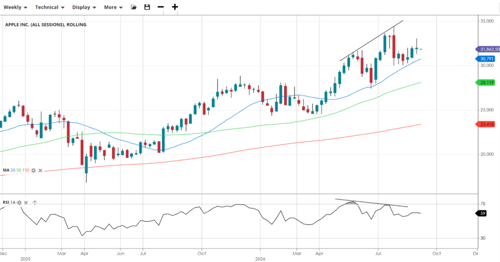
Source: SpreadEx | Apple, Weekly Chart
It's easy to open an account
- Fill in our simple online application form
- Fund your account
- Start trading the global markets instantly!
SEARCH FOR AN ARTICLE:
Enter a keyword and search for all relevant articlesMARKET ANALYSIS
RECENT POSTS
DISCLAIMER
Spread bets and CFDs are complex instruments and come with a high risk of losing money rapidly due to leverage. 61% of retail investors lose money when trading spread bets and CFDs with this provider. You should consider whether you understand how spread bets and CFDs work and whether you can afford to take the high risk of losing your money. For professional clients, spread betting and CFD trading can also result in losses larger than your initial stake or deposit.
Spreadex Ltd is authorised and regulated by the Financial Conduct Authority, provides an execution only service and does not provide advice in any way. Nothing within this update should be deemed to constitute the provision of investment advice, recommendations, any other professional advice in any way, or a record of our trading prices. This update does not constitute or form part of an offer of, or solicitation for a transaction in any financial instrument, nor shall it or the fact of its distribution form the basis of, or be relied on in connection with, any contract therefore. Any persons placing trades based on their interpretation of the comments or information within this update does so entirely at their own risk.
No representation, warranty, or undertaking, express or limited, is given as to the accuracy or completeness of the information or opinions contained within this update by Spreadex Ltd or any of its employees and no liability is accepted by such persons for the accuracy or completeness of any such information or opinions. As such, no reliance may be placed for any purpose on the information and opinions contained within this update.
The information contained within this update is the intellectual property of Spreadex Ltd and is protected by UK and International copyright laws. All rights reserved. Users may however freely download, distribute and reproduce extracts of the contents, subject always to accrediting Spreadex Ltd as the source and providing a hyperlink to www.spreadex.com.


