Financial Trading Blog
Buy the Nvidia 'Chinese Spy Affair' Dip?
Nvidia has lost more than a quarter of its value since its October record, and the weekly chart now shows a completed double top just as its founder faces the biggest scandal of his career.
Jensen Huang admitted on Sunday to an affair with a former executive at a chip customer whom US officials reportedly suspect of working for Chinese intelligence. The shares fell as much as 8.8% on Monday to $170.24 before closing down 4.3% at $178.67, even as the rest of the chip sector staged a powerful rebound.
Latest Market Moves
Nvidia had been trading around $179 in Tuesday pre-market, broadly steady after Monday's drop, which left the stock down around 4% for the year.
The Philadelphia Semiconductor Index (SOX) jumped 6.9% to 10,034 on Monday, clawing back part of last Thursday's 12.3% plunge, with AMD up 13.3% and Broadcom up 8.8%.
The Nasdaq 100 rose 3.4% to 27,908 and the S&P 500 gained 2.3% to 7,550 on Monday, leaving Nvidia as one of the few big losers in a broad rally.
Asian chip stocks shrugged off the scandal on Tuesday, with SK Hynix closing up 6.7% and TSMC up 2.2%.
An Affair With National Security Strings
The story has moved from the gossip columns to Washington in under two weeks.
The New York Times reported on 29 October that US intelligence believed Alice Huang, a former executive at Singapore-based Nvidia customer Megaspeed, may have been passing information to Beijing. Huang initially described Nvidia's dealings with Megaspeed as "normal and not unusual," adding: "We've studied all their deployments of our GPUs and counted every one."
On Sunday he told staff in an email: "I was unfaithful to my wife." Nvidia's board launched an investigation led by independent directors and outside counsel, saying it has "no reason to believe that either national security or NVIDIA secrets were compromised."
The pressure built on Monday, when President Trump told reporters "I know the FBI is looking into it," though he added "I think that he'll be in good shape." Senator Chris Coons called for a congressional investigation, and Rosen Law Firm filed a class action alleging that investors were misled. On Tuesday, Bloomberg reported that Chinese AI start-up Moonshot AI had rented servers in China fitted with Nvidia's top-end B300 chips, a claim Moonshot disputes.
What If the Board Shows Huang the Door?
Nvidia without Jensen Huang is a scenario the market has never had to price in.
Huang co-founded the company in 1993 and has run it ever since, steering it from gaming graphics cards to the heart of the AI boom. He is also its chief salesman and its main link to Washington, where his relationship with Trump has helped on export policy.
Nvidia has no publicly named successor, so a forced exit would open a leadership gap just as its Vera Rubin chips ramp up and rivals push their own designs. The board's stated "confidence in Jensen and his leadership team" suggests it isn't heading that way yet, but the FBI and any congressional probes are outside its control.
China may be the bigger commercial risk. Nvidia already assumes no data center revenue from China in its guidance, but evidence that chips leaked through overseas customers could invite tighter rules on sales to Southeast Asia and other third countries.
The Numbers Still Look Strong
Strip out the scandal, and the growth story hasn't cracked.
Revenue for the quarter to 26 July rose 106% from a year earlier to a record $96.2 billion, with data center sales up 117% to $89.0 billion and gross margin at 75%. Annual growth has accelerated in each of the last four quarters, from 56% in the July 2025 quarter.
Nvidia guided for revenue of $108 billion, plus or minus 2%, in the October quarter, with gross margin of around 74%. Results are due after the US close on 17 November, where consensus sits at revenue of $108.8 billion and earnings of $2.47 a share.
Signs of a Late-Cycle Chip Market?
If there are cracks, they are showing in the cash flow rather than the sales line.
Operating cash flow more than halved to $24.1 billion in the July quarter from $50.3 billion in the previous three months, as receivables swelled to $63.1 billion from $38.5 billion in January. Inventories rose to $31.6 billion from $21.4 billion over the same period, and Nvidia raised around $24.9 billion of new debt.
Customers taking longer to pay and stock building up are classic warning signs late in a hardware cycle, although one quarter doesn't make a trend. Guidance also implies sequential growth slowing to around 12% from 18%, so next week's numbers and outlook carry more weight than usual.
The sector was already jittery before the scandal broke. Last Thursday, Nvidia slumped 9.3% to $181.60, closing near the day's low, as the SOX dropped 12.3% amid doubts over whether data center spending can keep up its pace.
Nvidia Technical View: Double Top Confirmed
The weekly chart has turned decisively bearish.
Nvidia formed a double top with peaks at $236.54 in May and $243.37 in early October, and the RSI made a lower high on the second peak, a bearish divergence. The rising trendline from the April 2025 low at $86.62 gave way in late October, and last week's slump broke the $190 neckline set by the June and July lows.
The measured move (the height of the top projected down from the neckline) points to around $137-144, a distant target. First support comes at $164-165, where the March 2026 low of $164.27 lines up with the 50% retracement of the whole rally from April 2025 to October's high, while the weekly RSI at 37 is not yet oversold.
On the upside, the old neckline near $190 is now the first resistance, with the broken trendline up near $213. Only a recovery back above $190 would start to ease the bearish picture.
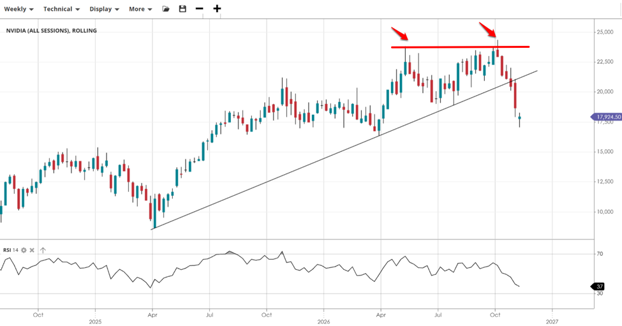
Source: SpreadEx | Nvidia, Weekly Chart
It's easy to open an account
- Fill in our simple online application form
- Fund your account
- Start trading the global markets instantly!
SEARCH FOR AN ARTICLE:
Enter a keyword and search for all relevant articlesMARKET ANALYSIS
RECENT POSTS
DISCLAIMER
Spread bets and CFDs are complex instruments and come with a high risk of losing money rapidly due to leverage. 64% of retail investors lose money when trading spread bets and CFDs with this provider. You should consider whether you understand how spread bets and CFDs work and whether you can afford to take the high risk of losing your money. For professional clients, spread betting and CFD trading can also result in losses larger than your initial stake or deposit.
Spreadex Ltd is authorised and regulated by the Financial Conduct Authority, provides an execution only service and does not provide advice in any way. Nothing within this update should be deemed to constitute the provision of investment advice, recommendations, any other professional advice in any way, or a record of our trading prices. This update does not constitute or form part of an offer of, or solicitation for a transaction in any financial instrument, nor shall it or the fact of its distribution form the basis of, or be relied on in connection with, any contract therefore. Any persons placing trades based on their interpretation of the comments or information within this update does so entirely at their own risk.
No representation, warranty, or undertaking, express or limited, is given as to the accuracy or completeness of the information or opinions contained within this update by Spreadex Ltd or any of its employees and no liability is accepted by such persons for the accuracy or completeness of any such information or opinions. As such, no reliance may be placed for any purpose on the information and opinions contained within this update.
The information contained within this update is the intellectual property of Spreadex Ltd and is protected by UK and International copyright laws. All rights reserved. Users may however freely download, distribute and reproduce extracts of the contents, subject always to accrediting Spreadex Ltd as the source and providing a hyperlink to www.spreadex.com.


