Financial Trading Blog
Brent Higher on Lower Inventories, Price Forecast
Crude prices rose sharply after the weekend pause in fighting came to an abrupt end and inventories dwindled, and analysts are once again upping their Brent forecasts for the year.
Key Points Driving the Market
- Brent is once again nearing $90 amid US attacks across Iran after the breakdown in negotiations earlier in the week.
- A notable drop in inventories has helped boost prices, as brokers raise Brent targets above triple digits for the next three months.
- Markets are growing increasingly convinced there will be no near-term end to the conflict, as geopolitical pressures might remain until the US midterm elections.
End to Conflict Remains Elusive
Markets started the week on a more positive note after the US and Iran signalled a pause in attacks amid renewed negotiations. However, the mood soured in just days after Iran launched missiles at US facilities in Jordan and US President Donald Trump said that Iran would be "hit hard" in response. The re-escalation occurred amid reports that US crude inventories drew down by 7.2 million barrels last week and that the Strategic Petroleum Reserve (SPR) hit a new low since the early 1980s. Commercial stockpiles are 7% below the seasonal average, suggesting growing pressure on supply. Brent broke above $90 per barrel on Wednesday following the news but retreated back below the level in early trading on Thursday.
As European traders came to their desks on Thursday, Brent was once again rocketing higher, towards $90, amid reports of explosions across Iran. There are now concerns that the war might spread, as Saudi forces launch attacks against Iran-aligned groups in Iraq and a drone hit a US-owned gas storage tanker in Egypt's Mediterranean waters. The more conciliatory rhetoric about negotiations from earlier in the week has vanished, though Brent still hasn't risen to triple digits like it did the last time hostilities resumed a month ago. Washington has signalled its intent to disengage from the conflict and resume oil shipments, but that appears to have emboldened Tehran in its efforts to secure control of the Strait. The conflict could persist until the US midterm elections in early November, as many analysts believe Trump wants to end it before then to lower gasoline prices and shore up popular support. A Democrat sweep in Congress amid an anti-war surge could significantly curtail his efforts to deal with Iran and provide a lifeline to Tehran. Barring a ground invasion, which is not technically feasible given the current force situation, there is little reason for either side to concede until the US midterm election.
Brokers See Crude Price Higher
As the conflict continues, analysts and brokers are once again raising their oil price targets after cutting them last month amid a more positive outlook as shipping resumed under the MOU. Barclays issued a note to clients suggesting that Brent could rise to $150 within three months. A summary of analysts' expectations compiled by Trading Economics indicated Brent at around $101 by the end of the quarter, which would be almost $10 higher than the current price. As the conflict carries on, more brokers could upgrade their price targets. However, in the on-again, off-again nature of the war, each time there has been a re-escalation, Brent has failed to break above prior highs as the market settles into a new normal with the Strait of Hormuz closed and Gulf states building out alternative infrastructure.
Brent DCB in the Making?
Despite being up, Brent’s sharp drop from $96 to $80 suggests the recent bounce might be a short-term recovery as part of a potential dead-cat bounce. With $90 holding strong and both bands on the 4-hour flattening out, the crude could revisit the lower end of the potential range. Losing that floor would open the door to $75. However, if bullish price action is sustained, taking over the $90 handle could lead prices back toward triple digits should $96 fails to form a double top.
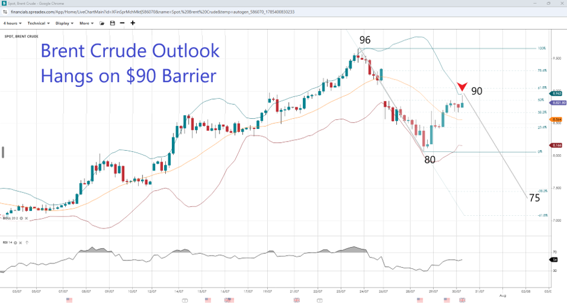
Source: SpreadEx | Brent, 4-hour Chart
It's easy to open an account
- Fill in our simple online application form
- Fund your account
- Start trading the global markets instantly!
SEARCH FOR AN ARTICLE:
Enter a keyword and search for all relevant articlesMARKET ANALYSIS
RECENT POSTS
DISCLAIMER
Spread bets and CFDs are complex instruments and come with a high risk of losing money rapidly due to leverage. 61% of retail investors lose money when trading spread bets and CFDs with this provider. You should consider whether you understand how spread bets and CFDs work and whether you can afford to take the high risk of losing your money. For professional clients, spread betting and CFD trading can also result in losses larger than your initial stake or deposit.
Spreadex Ltd is authorised and regulated by the Financial Conduct Authority, provides an execution only service and does not provide advice in any way. Nothing within this update should be deemed to constitute the provision of investment advice, recommendations, any other professional advice in any way, or a record of our trading prices. This update does not constitute or form part of an offer of, or solicitation for a transaction in any financial instrument, nor shall it or the fact of its distribution form the basis of, or be relied on in connection with, any contract therefore. Any persons placing trades based on their interpretation of the comments or information within this update does so entirely at their own risk.
No representation, warranty, or undertaking, express or limited, is given as to the accuracy or completeness of the information or opinions contained within this update by Spreadex Ltd or any of its employees and no liability is accepted by such persons for the accuracy or completeness of any such information or opinions. As such, no reliance may be placed for any purpose on the information and opinions contained within this update.
The information contained within this update is the intellectual property of Spreadex Ltd and is protected by UK and International copyright laws. All rights reserved. Users may however freely download, distribute and reproduce extracts of the contents, subject always to accrediting Spreadex Ltd as the source and providing a hyperlink to www.spreadex.com.


