Financial Trading Blog
US Indices in Correction: Rebound or Further Down
The Nasdaq and DJIA both entered correction territory, with the tech-heavy index under particular strain beyond the potential repercussions of the war in the Middle East.
The Market-Moving Developments
- Major US indices entered a correction after five weeks of losses, with the Nasdaq the worst performer.
- While uncertainty around the war has pressured equities, the Nasdaq is particularly vulnerable given concerns around private credit exposure to software companies.
- The rotation from tech to industrials has effectively ended amid concerns about higher inflation.
- Rising rates could worsen credit issues affecting tech stocks as well as weigh on high-valuation software stocks, putting particular pressure on the Nasdaq.
Tech Stocks Weighed By AI, Credit Exposure
US indices have recorded five consecutive weeks of losses across the board, with both the DJIA and Nasdaq falling more than 10% from their peaks, officially entering correction. Given the market disruption from the war in the Middle East and heightened expectations for Fed hawkishness, the surprise isn't so much that US equities are in correction territory as that it took so long to happen. The easiest explanation for the drop is simply that traders fear rising costs, which would slow business and consumer activity and hurt the return on investment from equities. But US stocks, in particular, have managed to avoid the losses of their Asian and European peers, as energy costs are not expected to rise as much. Offsetting losses from exposure to the Middle East, US oil companies are projected to reap profits from higher global energy prices and increased sales. However, that narrative could be starting to crack as the war enters its second month and more infrastructure is affected. Iranian airstrikes damaged two major aluminium plants in the Middle East as the war escalated over the weekend, potentially raising the cost of industrial metals alongside already rising fertiliser and chemical prices.
While this narrative can explain declines in global equities, it doesn't explain why the tech-heavy Nasdaq is the worst-performing major US index. The war might get most of the attention and overshadow other underlying issues, but that doesn't mean those problems have gone away. Traders were already worried about the situation for software providers as AI makes coding much easier, and concerns about private credit exposure to software firms have only grown as headlines have focused on Iran. Many tech and edge companies rely on private credit instead of traditional financing, given the high risk of their ventures. The concern is that a loss of creditworthiness among software companies disrupted by AI could trigger a cascading effect across the financial system. Even if it doesn't lead to a full-blown financial crisis, private equity is restricting its investments in software firms, making it harder for those companies to fund themselves. This is a particular problem for high-valuation companies that need to grow to satisfy investor expectations.
Upwards, Downwards, or Rotation?
Traders who were concerned about software companies being disrupted by AI in January and February were rotating into more defensive stocks, such as those in the DJIA. But this play has evaporated, as industrial firms are now likely to be adversely affected by higher inflation, effectively ending the rotation trade. Amid the uncertainty, investors have instead opted out of equities, with the Nasdaq the most vulnerable to rising yields as the war persists. While markets jump or fade on hopes of a ceasefire or other end to the conflict, the trend for the Nasdaq, in particular, might be downward until the uncertainty around future rate hikes and the private credit situation is resolved.
Nasdaq Double Top Neckline Breakdown
Following the peak at 26250 and subsequent move under the 24k support, the Nasdaq has confirmed a bearish breakout after trading for at least three sessions below support. Notably, the breakdown point appears to be the neckline support of a double top pattern, which often extends the height of the pattern that currently spans 2550 points. If the text-heavy US index fails to reclaim 23k and the 23500 swing support, the odds of sliding towards 21750 will increase, especially if 22660 gives way to bears. On the upside, bulls must reclaim the neckline support to make a respectable attempt to reverse the recent bearish course of the Nasdaq.
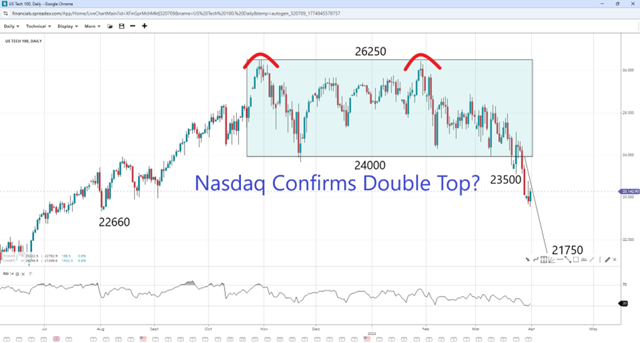
Source: SpreadEx | US Tech 100, Daily Chart
It's easy to open an account
- Fill in our simple online application form
- Fund your account
- Start trading the global markets instantly!
SEARCH FOR AN ARTICLE:
Enter a keyword and search for all relevant articlesMARKET ANALYSIS
RECENT POSTS
DISCLAIMER
Spread bets and CFDs are complex instruments and come with a high risk of losing money rapidly due to leverage. 61% of retail investors lose money when trading spread bets and CFDs with this provider. You should consider whether you understand how spread bets and CFDs work and whether you can afford to take the high risk of losing your money. For professional clients, spread betting and CFD trading can also result in losses larger than your initial stake or deposit.
Spreadex Ltd is authorised and regulated by the Financial Conduct Authority, provides an execution only service and does not provide advice in any way. Nothing within this update should be deemed to constitute the provision of investment advice, recommendations, any other professional advice in any way, or a record of our trading prices. This update does not constitute or form part of an offer of, or solicitation for a transaction in any financial instrument, nor shall it or the fact of its distribution form the basis of, or be relied on in connection with, any contract therefore. Any persons placing trades based on their interpretation of the comments or information within this update does so entirely at their own risk.
No representation, warranty, or undertaking, express or limited, is given as to the accuracy or completeness of the information or opinions contained within this update by Spreadex Ltd or any of its employees and no liability is accepted by such persons for the accuracy or completeness of any such information or opinions. As such, no reliance may be placed for any purpose on the information and opinions contained within this update.
The information contained within this update is the intellectual property of Spreadex Ltd and is protected by UK and International copyright laws. All rights reserved. Users may however freely download, distribute and reproduce extracts of the contents, subject always to accrediting Spreadex Ltd as the source and providing a hyperlink to www.spreadex.com.


