Financial Trading Blog
Solid AI Results Boost Nasdaq to New Records
Despite the situation in the Middle East and a more hawkish Fed, US tech stocks are leading the Nasdaq to new records, with rotation into tech returning amid renewed confidence that AI will lead the way.
Factors Moving the Market
- US tech stocks are leading the way higher amid solid earnings and continued demand for chips and memory.
- Solid US economic data suggests the economy might have turned a corner and is accelerating despite the war.
- Higher inflation leaves the Fed on hold while raising the odds of a hike.
- Markets remain vulnerable to a shock if the war in the Middle East goes hot again, but analysts are bullish after most companies have reported earnings.
Solid Tech Earnings Boost Nasdaq to Record
The premier US tech index is back to record highs after a bit of profit-taking and market jitters over the weekend amid the situation in Iran, building on last week's success. Last Wednesday was the Champions League final of tech stocks, as most of the Magnificent 7 reported earnings right after the Fed's rate decision. Although there were some differences in the outcomes (Google rocketed higher, Meta fell back), the overall consensus was that growth is solid. Particularly, capital expenditures remain robust, with traders hoping they will fuel growth in the AI-baked sector for months, if not years, to come. While demand for AI remains solid, investors are also still worried about the disruption it will have in the software space. Palantir's earnings on Tuesday were the latest to be hit by investor unease. Despite posting an 85% revenue increase over the last year, the company failed to impress investors.
The gains in the Nasdaq also come despite the market solidifying its hawkish view of the Fed. Before last week's meeting, the market was pricing in about a 20% chance of a cut by the end of the year. Now that has shifted to a more than 30% chance of a hike. The market dynamics have shifted, as proven by the performance of the main indices last month. April saw the largest monthly gain for the Nasdaq since April of 2020 and, for the S&P 500, the largest percentage gain since November of the same year. The underperformance of the industrial-heavy DJIA is notable, as higher energy prices are likely to impact manufacturers and other businesses with smaller margins. The earlier theme of rotating out of tech stocks might be reversing as higher crude prices from the war prompt traders to renew bets on AI.
Momentum Is On the Bullish Side
The US economy is expected to have accelerated to 2.0% in the first quarter, despite the uncertainty caused by the war. Meanwhile, initial jobless claims fell to their lowest level since 1969, suggesting the jobs market may have hit a bottom and that March's strong hiring numbers were not an outlier. A recovering economy could boost equities even if the Fed is unable to cut rates as profits rise and whet risk appetite. While analysts are bullish on tech in general, the underperformance of Meta and Microsoft last week suggests investors still have concerns, particularly about large spending and the risks to software companies. And the market stumble on Monday suggests remaining vulnerability if the war in the Middle East suddenly heats up.
Nasdaq at Risk of VWAP Rejection at Record Highs
The spike in the Nasdaq on Tuesday has brought the tech index to VWAP resistance, with the upper band starting to look down suggesting decreasing volume, particularly as the RSI remains in overbought territory. If resistance holds firm, the Tech 100 index could start to roll over, potentially pulling back towards the mid VWAP under 27K. However, if the rally extends further, the next logical resistance levels to watch are the round 28250 and 28500 levels, given that the Nasdaq is in price discovery mode.
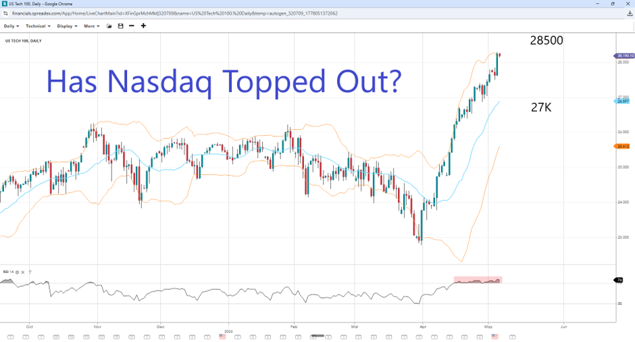
Source: SpreadEx | US Tech 100 Daily
It's easy to open an account
- Fill in our simple online application form
- Fund your account
- Start trading the global markets instantly!
SEARCH FOR AN ARTICLE:
Enter a keyword and search for all relevant articlesMARKET ANALYSIS
RECENT POSTS
DISCLAIMER
Spread bets and CFDs are complex instruments and come with a high risk of losing money rapidly due to leverage. 61% of retail investors lose money when trading spread bets and CFDs with this provider. You should consider whether you understand how spread bets and CFDs work and whether you can afford to take the high risk of losing your money. For professional clients, spread betting and CFD trading can also result in losses larger than your initial stake or deposit.
Spreadex Ltd is authorised and regulated by the Financial Conduct Authority, provides an execution only service and does not provide advice in any way. Nothing within this update should be deemed to constitute the provision of investment advice, recommendations, any other professional advice in any way, or a record of our trading prices. This update does not constitute or form part of an offer of, or solicitation for a transaction in any financial instrument, nor shall it or the fact of its distribution form the basis of, or be relied on in connection with, any contract therefore. Any persons placing trades based on their interpretation of the comments or information within this update does so entirely at their own risk.
No representation, warranty, or undertaking, express or limited, is given as to the accuracy or completeness of the information or opinions contained within this update by Spreadex Ltd or any of its employees and no liability is accepted by such persons for the accuracy or completeness of any such information or opinions. As such, no reliance may be placed for any purpose on the information and opinions contained within this update.
The information contained within this update is the intellectual property of Spreadex Ltd and is protected by UK and International copyright laws. All rights reserved. Users may however freely download, distribute and reproduce extracts of the contents, subject always to accrediting Spreadex Ltd as the source and providing a hyperlink to www.spreadex.com.


