Financial Trading Blog
Apple Earnings Preview: Still the Anti-AI Trade?
Apple heads into tonight's results as the world's largest company again, having overtaken Nvidia as investors fled the AI spenders.
The iPhone maker reports its fiscal fourth quarter (the July to September period) after the US close on Monday, its first set of numbers under new CEO John Ternus. The shares hit a record high last week after four straight monthly gains, so the bar is high going into a quarter shaped by memory costs, supply limits and a bumpy iPhone Duo launch.
Latest Market Moves
The Nasdaq 100 fell as low as 28,093 on Friday before closing down 3.5% at 28,385, rounding off a near-7% slide in October, its worst month since April 2025.
Nvidia dropped as much as 6% to $200.92 on Friday before closing down 4.2% at $204.64, leaving it around 16% below its record high and with a market value of roughly $4.93 trillion.
The Philadelphia Semiconductor Index slumped 7.2% on Friday as Intel plunged 28.6% on a disappointing outlook and AMD lost 10.9%.
Apple dipped as low as $334.35 on Friday before recovering to close down 1.2% at $344.63, still up around 3.5% for October against the tech sell-off.
Back on Top as AI Stocks Sell Off
Apple's decision to stay out of the data centre arms race has turned into its biggest selling point.
Its market value stood at about $5.03 trillion at Friday's close, ahead of Nvidia's $4.93 trillion, as investors worried about the scale of AI capex and the cash being burned to fund it. While the Nasdaq 100 sank in October, Apple set a record close of $348.91 on Thursday and is up around 27% so far this year, outperforming Microsoft, Alphabet, Meta and Amazon.
The gap with Nvidia is narrow, though, and Monday's pre-market moves had squeezed it to almost nothing. Rather than build its own frontier models, Apple partnered with Google's Gemini this year, focusing on putting AI into its products and software.
Five Straight Quarters of Beats
Apple has topped both revenue and earnings forecasts in each of the last five quarters.
Fiscal quarter | Revenue | YoY growth | EPS | EPS consensus | Revenue / EPS |
Q3 FY25 (Jun 2025) | $94.04bn | +9.6% | $1.57 | $1.43 | Beat / Beat |
Q4 FY25 (Sep 2025) | $102.47bn | +7.9% | $1.85 | $1.77 | Beat / Beat |
Q1 FY26 (Dec 2025) | $143.76bn | +15.7% | $2.84 | $2.67 | Beat / Beat |
Q2 FY26 (Mar 2026) | $111.18bn | +16.6% | $2.01 | $1.94 | Beat / Beat |
Q3 FY26 (Jun 2026) | $109.42bn | +16.4% | $2.02 | $1.88 | Beat / Beat |
Q4 FY26 (Sep 2026) consensus | ~$113.4bn | ~+11% | ~$1.99 | - | Due tonight |
Tonight's consensus points to the slowest revenue growth in four quarters, with iPhone sales seen up about 15% to roughly $56.5 billion and Services up almost 10% to around $31.6 billion. A beat isn't always enough, though: after July's results, the shares fell as much as 10% to $300 before closing down 7.4%, as guidance for 9% to 11% growth flagged supply and currency constraints.
iPhone Duo: Strong Demand, Teething Problems
Apple's first foldable has drawn long waiting lists, but the launch hasn't been smooth.
The iPhone Duo opened for pre-orders on 16 October and went on sale a week later, so it won't feature in tonight's numbers but will shape December-quarter guidance. Longer wait times point to strong demand, and Apple's main assembler has said it is confident of meeting the surge, according to Bloomberg News.
Against that, some buyers have reported cracked screens and hinge issues shortly after purchase, and many apps aren't yet optimised for the folding display. That's an unusual look for a company known for waiting until a product is close to perfect, and it comes alongside the first touchscreen MacBooks and the new HomeView device.
Memory Costs and Supply Risks
The AI boom Apple has sidestepped is still affecting component supply and costs.
Hyperscaler demand has sent memory and flash storage prices soaring, eroding the leverage Apple used to have over chip suppliers. Apple has raised prices across much of its line-up in response, including $100 increases on some iPhone models, which puts the focus on whether customers keep upgrading at the usual pace.
Gross margin is expected to come in between 47% and 48%, down from about 50% in the June quarter. Any comment on component availability will matter too, since supply limits were one of the reasons July's guidance disappointed.
First Call for John Ternus
Tonight is Ternus's first earnings call since he succeeded Tim Cook as CEO at the start of September.
The former head of hardware engineering has already sped up the pace of launches and recently defended Apple's measured approach to AI. "We don't want to ship AI for AI's sake," he told WIRED, adding that "when we're doing it right, people won't have to think about whether it was AI that made this happen." It is also Apple's first Monday earnings release since 2015.
Apple Technical Analysis
Apple's uptrend is intact, but momentum has been fading with each new high.
The stock is trading above its 20, 50, 100 and 200-day moving averages, which are stacked in bullish order, and last month it broke above September's $345.34 peak to set a record of $351.73 on 23 October.
However, the 14-day RSI has made a series of lower highs, from around 69 in late July to 67 in late September and 65 at the October peak, a bearish divergence that suggests buying pressure is weakening.
A move back below the breakout zone around $345 and the 20-day average near $342 would put the 50-day average at about $333 and the 1 October low of $325.81 in focus. A strong reaction to the results that clears $351.73 would ease divergence concerns and point to further gains.
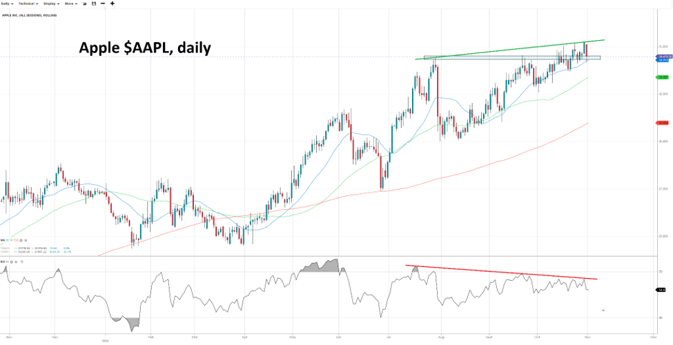
Source: SpreadEx | Apple, Daily Chart
It's easy to open an account
- Fill in our simple online application form
- Fund your account
- Start trading the global markets instantly!
SEARCH FOR AN ARTICLE:
Enter a keyword and search for all relevant articlesMARKET ANALYSIS
RECENT POSTS
DISCLAIMER
Spread bets and CFDs are complex instruments and come with a high risk of losing money rapidly due to leverage. 64% of retail investors lose money when trading spread bets and CFDs with this provider. You should consider whether you understand how spread bets and CFDs work and whether you can afford to take the high risk of losing your money. For professional clients, spread betting and CFD trading can also result in losses larger than your initial stake or deposit.
Spreadex Ltd is authorised and regulated by the Financial Conduct Authority, provides an execution only service and does not provide advice in any way. Nothing within this update should be deemed to constitute the provision of investment advice, recommendations, any other professional advice in any way, or a record of our trading prices. This update does not constitute or form part of an offer of, or solicitation for a transaction in any financial instrument, nor shall it or the fact of its distribution form the basis of, or be relied on in connection with, any contract therefore. Any persons placing trades based on their interpretation of the comments or information within this update does so entirely at their own risk.
No representation, warranty, or undertaking, express or limited, is given as to the accuracy or completeness of the information or opinions contained within this update by Spreadex Ltd or any of its employees and no liability is accepted by such persons for the accuracy or completeness of any such information or opinions. As such, no reliance may be placed for any purpose on the information and opinions contained within this update.
The information contained within this update is the intellectual property of Spreadex Ltd and is protected by UK and International copyright laws. All rights reserved. Users may however freely download, distribute and reproduce extracts of the contents, subject always to accrediting Spreadex Ltd as the source and providing a hyperlink to www.spreadex.com.


