Financial Trading Blog
US Banks Q3 Earnings Preview
Wall Street's biggest lenders open the third-quarter earnings season this week, and things are looking a good bit different since July's blowout numbers.
JPMorgan Chase, Wells Fargo, Goldman Sachs and Citigroup report on Tuesday, followed by Bank of America and Morgan Stanley on Wednesday, with regional lenders such as PNC, U.S. Bancorp and Truist later in the week.
Commercial Banking: Higher Rates Cut Both Ways
For the lending side of the business, September's rate hike is a mixed blessing.
Higher short-term rates lift the yield on loans and floating-rate assets, and Bank of America's guidance for 2026 net interest income growth at the top of its 6-8% range was built on a forward curve that already assumed the September move. Loan demand is holding up too, with Wells Fargo CFO Mike Santomassimo expecting loan growth this year to beat the bank's earlier forecast.
The flip side is funding costs and bond values. The US 10-year Treasury yield climbed to a 24-year high above 5.3% in early October, which pushes up deposit costs and dents the value of securities portfolios, although banks have shortened the duration of those holdings since the 2023 regional banking scare.
Credit has been the quiet positive so far, with JPMorgan cutting its card charge-off forecast to around 3.2% in July, so any sign that higher borrowing costs and pricey fuel are starting to bite consumers will be closely watched.
Investment Banking: Cooling After a Record First Half
Wall Street's dealmaking engines are coming off the boil after a spectacular first half.
The second quarter delivered record equities trading revenue at Goldman Sachs, Morgan Stanley and Bank of America, a wave of $10bn-plus mega-mergers and SpaceX's record-breaking IPO in June.
The spike in yields changed the mood in late September, with Oura and SB Energy postponing their listings, and the value of announced M&A in the third quarter fell roughly 10% from a year earlier.
Management guidance points to a widening gap between the banks. Goldman's David Solomon has flagged a muted quarter with fixed income softer but equities strong, and Bank of America's Brian Moynihan warned that investment banking fees could fall more than 10% year on year. JPMorgan Co-President Doug Petno, by contrast, guided for a "mid-to-high teens" rise in investment banking fees and markets revenue.
JPMorgan Chase (JPM)
Reports | Tuesday 13 October, before the US open |
Adjusted EPS consensus | $5.93 |
Revenue consensus | $51.2bn |
EPS beats, last 5 quarters | 4 out of 5 |
JPMorgan is the industry's all-rounder, and stronger deposits and higher rates led it to raise its 2026 net interest income forecast to about $105.5bn in July, while management has guided for a mid-to-high teens rise in investment banking fees and markets revenue in Q3. The main question marks are rising expenses and a premium valuation that leaves little room for disappointment.
Wells Fargo (WFC)
Reports | Tuesday 13 October, before the US open |
Adjusted EPS consensus | $1.85 |
Revenue consensus | $22.3bn |
EPS beats, last 5 quarters | 3 out of 5 |
Wells Fargo is in growth mode after regulators lifted its asset cap in June 2025, with average loans up around 12% year on year in Q2 and the CFO expecting full-year loan growth to beat guidance. The catch is some net interest margin compression flagged for Q3, and Wells has been the least consistent of the big six, missing EPS forecasts in two of the last five quarters.
Citigroup (C)
Reports | Tuesday 13 October, before the US open |
Adjusted EPS consensus | $2.65 |
Revenue consensus | $23.7bn |
EPS beats, last 5 quarters | 4 out of 5 |
Citi is three years into Jane Fraser's overhaul, with the CFO guiding for returns slightly above its 11% target this year and bigger buybacks as stake sales in Mexico's Banamex free up capital. Heavy restructuring costs and exposure to the slowdown in fixed income trading are the main risks.
Goldman Sachs (GS)
Reports | Tuesday 13 October, before the US open |
Adjusted EPS consensus | $12.86 |
Revenue consensus | $16.8bn |
EPS beats, last 5 quarters | 5 out of 5 |
Goldman is the purest play on capital markets among the big six and is coming off a record Q2, when equities trading revenue hit $7.42bn and EPS beat forecasts by around 45%. Solomon has already warned of a muted Q3 with fixed income softer, and the late-September IPO delays hit Goldman harder than its more diversified rivals.
Bank of America (BAC)
Reports | Wednesday 14 October, before the US open |
Adjusted EPS consensus | $1.10 |
Revenue consensus | $30.6bn |
EPS beats, last 5 quarters | 5 out of 5 |
Bank of America is the most rate-sensitive of the big lenders, guiding for 2026 net interest income growth at the top of its 6-8% range on the back of 12 straight quarters of deposit growth. The weak spot is dealmaking, after Moynihan's warning that investment banking fees could fall more than 10% in Q3 knocked the shares around 5% in mid-September.
Morgan Stanley (MS)
Reports | Wednesday 14 October, before the US open |
Adjusted EPS consensus | $2.93 |
Revenue consensus | $19.9bn |
EPS beats, last 5 quarters | 5 out of 5 |
Morgan Stanley has rebuilt itself around wealth management, which brought in a record $148bn of net new assets in Q2, and Co-President Dan Simkowitz says the investment banking pipeline looks robust as the AI investment cycle continues. However, he also said Q3 was running well below Q2, and wealth fees remain exposed if higher yields drag equity markets lower.
US Financials Pull Back Inside Their Uptrend
The US Financial Sector Index ETF, dominated by the large banks, has retreated from its peak, but the longer-term uptrend is still intact on the weekly chart.
US Financials (XLF) has been climbing inside a rising channel since mid-2024 and peaked at 5,859.50 in late summer, turning lower near the top of that channel. The pullback took it to around 5,300 at the start of October, and it had been trading around 5,470 heading into Monday's session. RSI has dropped from close to 70 to just under 50, unwinding the excess without signalling a breakdown.
A recovery above 5,600 would put the peak back in focus, with the upper channel line now near 5,950. A disappointing set of results could instead send the market back towards the lower channel line, around 5,050-5,100, which caught the major dips in April 2025 and March 2026.
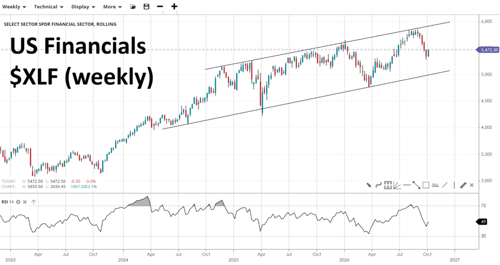
Source: SpreadEx | US Financials (XLF), Weekly Chart
It's easy to open an account
- Fill in our simple online application form
- Fund your account
- Start trading the global markets instantly!
SEARCH FOR AN ARTICLE:
Enter a keyword and search for all relevant articlesMARKET ANALYSIS
RECENT POSTS
DISCLAIMER
Spread bets and CFDs are complex instruments and come with a high risk of losing money rapidly due to leverage. 61% of retail investors lose money when trading spread bets and CFDs with this provider. You should consider whether you understand how spread bets and CFDs work and whether you can afford to take the high risk of losing your money. For professional clients, spread betting and CFD trading can also result in losses larger than your initial stake or deposit.
Spreadex Ltd is authorised and regulated by the Financial Conduct Authority, provides an execution only service and does not provide advice in any way. Nothing within this update should be deemed to constitute the provision of investment advice, recommendations, any other professional advice in any way, or a record of our trading prices. This update does not constitute or form part of an offer of, or solicitation for a transaction in any financial instrument, nor shall it or the fact of its distribution form the basis of, or be relied on in connection with, any contract therefore. Any persons placing trades based on their interpretation of the comments or information within this update does so entirely at their own risk.
No representation, warranty, or undertaking, express or limited, is given as to the accuracy or completeness of the information or opinions contained within this update by Spreadex Ltd or any of its employees and no liability is accepted by such persons for the accuracy or completeness of any such information or opinions. As such, no reliance may be placed for any purpose on the information and opinions contained within this update.
The information contained within this update is the intellectual property of Spreadex Ltd and is protected by UK and International copyright laws. All rights reserved. Users may however freely download, distribute and reproduce extracts of the contents, subject always to accrediting Spreadex Ltd as the source and providing a hyperlink to www.spreadex.com.


