Financial Trading Blog
Cable Steady Ahead of UK Monthly GDP
The UK economy is expected to have rebounded, which could give the Chancellor more headroom, but traders are pricing in a higher chance of a BOE hike after the US-Iran war resumes.
Factors Moving the Market
- Analysts expect the UK economy to bounce back to +0.1% growth in May.
- The pound is holding up against the dollar as the BOE and Fed are seen as more hawkish amid rising inflationary pressure.
- Growth could be key for the pound as markets navigate uncertainty over who will be the next Chancellor and whether there will be a change in fiscal rules.
UK Economy Expected to Rebound
The pound has held its ground against a stronger dollar over the last week, with cable trading generally sideways. Part of that stems from the dynamics of interest rate expectations. As the conflict in the Middle East reignites, investors are once again worried about inflation pressures and are pricing in a higher chance of rate hikes from both the Fed and the BOE. This has kept the outlook for the interest rate gap fairly steady, making growth the main differentiating factor among the currencies. While the US economy has remained largely green across the board, albeit with some softer signs in the jobs market lately, the UK posted negative GDP growth in April. The contraction was attributed mainly to the market adjusting to the impact of higher energy prices. As the conflict eased and domestic political issues emerged, the expectation is that a June economic rebound will affirm the incoming government's commitment to the current fiscal rules. If the economy fails to rebound, the pound could suffer as it raises uncertainty about the UK's fiscal policy future.
The consensus is for the UK June monthly GDP to reverse the prior month, growing +0.1% compared to -0.1% in May. This would bring the rolling three-month growth rate to 0.5% from 0.7% previously. The improvement is expected to be partially aided by a slight reduction in the trade deficit to £23.6 billion from -£26.1 billion in May. UK Chancellor Rachel Reeves, who is widely expected to be replaced in the new Andy Burnham government, delivered her third Mansion House speech on Tuesday, touting economic growth in what was seen as a bid to at least preserve the current fiscal status quo, if not her job. A solid GDP number would reassure investors that the government has sufficient budget headroom to address the situation without resorting to new taxes or borrowing.
New Chancellor, New Hikes
The UK's Office for Budget Responsibility warned that the public debt was becoming "unsustainable", giving new emphasis to the growth issue. Investors are wary of the favoured replacement for Reeves, former Labour leader Ed Miliband, given his strong support for green energy spending during an energy crisis. Other candidates being considered as "safer" include Starmer loyalist and current Foreign Secretary Yvette Cooper. The uncertainty around fiscal policy could weigh on sterling, while BOE Chief Economist Huw Pill warned that interest rates might need to rise later this year. That could put additional downward pressure on the economy, which would be a problem for investors if growth is already stagnating. The upcoming GDP numbers could be decisive for whether the pound continues to hold up against the greenback or declines.
Pound in Waiting Mode Ahead of GDP
The GBPUSD has been consolidating since the bounce from 1.3320, facing resistance at 1.3450, with price action slightly tightening, resembling a pennant or triangle pattern. If the lower VWAP at 1.3340 cracks, it could signal a double top, paving the way for 1.3300. On the flip side, a break above the upper VWAP at 1.3428 and the regional peak at 1.3450 would expose 1.3500.
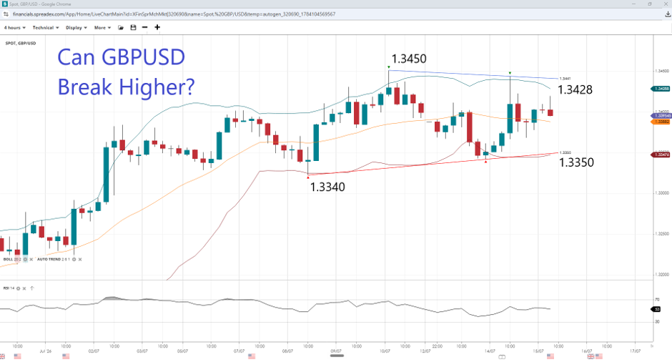
Source: SpreadEx | GBPUSD, 4-hour Chart
It's easy to open an account
- Fill in our simple online application form
- Fund your account
- Start trading the global markets instantly!
SEARCH FOR AN ARTICLE:
Enter a keyword and search for all relevant articlesMARKET ANALYSIS
RECENT POSTS
DISCLAIMER
Spread bets and CFDs are complex instruments and come with a high risk of losing money rapidly due to leverage. 61% of retail investors lose money when trading spread bets and CFDs with this provider. You should consider whether you understand how spread bets and CFDs work and whether you can afford to take the high risk of losing your money. For professional clients, spread betting and CFD trading can also result in losses larger than your initial stake or deposit.
Spreadex Ltd is authorised and regulated by the Financial Conduct Authority, provides an execution only service and does not provide advice in any way. Nothing within this update should be deemed to constitute the provision of investment advice, recommendations, any other professional advice in any way, or a record of our trading prices. This update does not constitute or form part of an offer of, or solicitation for a transaction in any financial instrument, nor shall it or the fact of its distribution form the basis of, or be relied on in connection with, any contract therefore. Any persons placing trades based on their interpretation of the comments or information within this update does so entirely at their own risk.
No representation, warranty, or undertaking, express or limited, is given as to the accuracy or completeness of the information or opinions contained within this update by Spreadex Ltd or any of its employees and no liability is accepted by such persons for the accuracy or completeness of any such information or opinions. As such, no reliance may be placed for any purpose on the information and opinions contained within this update.
The information contained within this update is the intellectual property of Spreadex Ltd and is protected by UK and International copyright laws. All rights reserved. Users may however freely download, distribute and reproduce extracts of the contents, subject always to accrediting Spreadex Ltd as the source and providing a hyperlink to www.spreadex.com.


