Financial Trading Blog
Can Nvidia Earnings Offset Jensen's Fallout?
Nvidia reports after tonight's US close without Jensen Huang for the first time, and investors care as much about who runs the company as about what it sold.
Huang resigned as CEO and left the board on Thursday, with finance chief Colette Kress named interim CEO while the board looks for a permanent successor. The shares have lost about 16% since Huang admitted the affair on 8 November and closed on Monday some 36% below October's record high.
Latest Market Moves
Nvidia fell as much as 4.8% to $155.01 on Monday before closing down 4.1% at $156.14, its third straight daily loss, leaving its market value at around $3.8 trillion.
The Philadelphia Semiconductor Index dropped 5.3% to 9,611 on Monday, with AMD down 5.6%, the TSMC ADR down 6.3% and Broadcom down 3.9%.
AI infrastructure names that lean on Nvidia funding also slid on Monday, with CoreWeave down 6.1% and Oracle down 5.0%.
The Nasdaq 100 lost 2.7% to 27,197 and the S&P 500 fell 1.9% to 7,417 on Monday, both at one-week lows, while Nasdaq 100 futures were little changed in early Tuesday trade.
More Than Just a Missing CEO
The market isn't only losing a chief executive, it's losing Nvidia's chief salesman, dealmaker and main line to the White House.
Huang co-founded the company in 1993 and ran it for 33 years, fronting the customer deals and the lobbying on export rules that underpinned the AI boom. His close ties with President Trump helped reopen China to Nvidia's H200 chips, and nobody else at the company has that kind of access.
The days since have added to the uncertainty rather than easing it. Treasury Secretary Scott Bessent on Sunday called for a "dramatic shakeup" and urged the board to pick an outside CEO, while on Monday Trump and a group of tech executives including Elon Musk backed calls to bring Huang back, something CNBC reported the board isn't considering.
Washington Moves to Close the Back Door
The bigger commercial risk may be what the scandal does to export policy.
The Wall Street Journal reported that Singapore-based Megaspeed, where the woman at the centre of the scandal was an executive, arranged to ship nearly $12 billion of top Nvidia chips to China between March 2024 and June 2025, though actual deliveries are unclear.
On Monday, the Commerce Department issued a rule blocking Chinese firms from renting advanced chips on servers abroad, and the Journal reported that licence rules for exports to Malaysia, Indonesia and Singapore are being drafted.
Democrats won control of both chambers of Congress in the 3 November midterms and take over in January, which hands them subpoena power over the H200 approvals they are already probing.
Nvidia's guidance already assumes no data center compute revenue from China. The risk is wider than that, though, since tighter licensing in Southeast Asia could slow sales to some of its fastest-growing regions.
Can Kress Steady Nerves by Spending Less?
Kress's best card for reassuring shareholders could be the one that worries the rest of the AI trade.
As finance chief, she pushed back on some of Huang's biggest deals. Spending less on customer deals, alongside a bigger buyback from the $99 billion still authorised, would tell investors that more of Nvidia's profit stays with shareholders. That message could land well after a July quarter in which operating cash flow more than halved as receivables and inventories swelled.
The catch is that Nvidia's money has helped fund the buyers of its chips. A pullback could squeeze neoclouds like CoreWeave, already down 23% in a month, and test appetite for AI listings like Anthropic's, due on Thursday, so what helps Nvidia's margins could hurt other AI stocks even more.
Earnings Preview: Five Straight Beats
Nvidia has topped revenue and earnings forecasts in each of the last five quarters.
Fiscal quarter | Revenue | Revenue consensus | EPS | EPS consensus | Revenue / EPS |
Q2 FY26 (Jul 2025) | $46.74bn | $46.06bn | $1.05 | $1.01 | Beat / Beat |
Q3 FY26 (Oct 2025) | $57.01bn | $54.92bn | $1.30 | $1.25 | Beat / Beat |
Q4 FY26 (Jan 2026) | $68.13bn | $66.21bn | $1.62 | $1.53 | Beat / Beat |
Q1 FY27 (Apr 2026) | $81.62bn | $79.15bn | $1.87 | $1.77 | Beat / Beat |
Q2 FY27 (Jul 2026) | $96.22bn | $92.17bn | $2.22 | $2.09 | Beat / Beat |
Q3 FY27 (Oct 2026) | Due tonight | ~$109.2bn | Due tonight | ~$2.47 | - |
Tonight's consensus points to revenue up about 92% from a year earlier, slightly above Nvidia's own guidance of $108 billion, plus or minus 2%, with data center sales expected to reach almost $102 billion. Beats haven't guaranteed gains, though, as the shares fell after four straight beats before finally rising after August's results.
The numbers for the October quarter were largely locked in before the scandal, so guidance for the January quarter and any update on August's call for around 70% revenue growth in fiscal 2028 will matter more.
Nvidia Technical View: Back at the 2024 Highs
The weekly chart shows Nvidia testing a major support zone after a near-vertical drop.
Last week's slide broke the $164 support level set by the September 2025 and March 2026 lows, which now becomes the first resistance. Thursday's plunge to $148.80 stopped at the top of the $141-149 area, which capped the shares several times between June 2024 and January 2025 and has now turned into support.
The rising trendline from the 2023 lows, through the April 2025 low of $86, now sits near $140, adding weight to that zone. It also lines up with the $137-144 target from the double top completed earlier this month, while the weekly RSI is at around 31, close to oversold and its lowest reading in more than three years.
A weekly close below $140 would break the trendline for the first time since 2023 and open the way to deeper losses. On the upside, a strong reaction to tonight's results would need to retake $164 to ease the pressure.
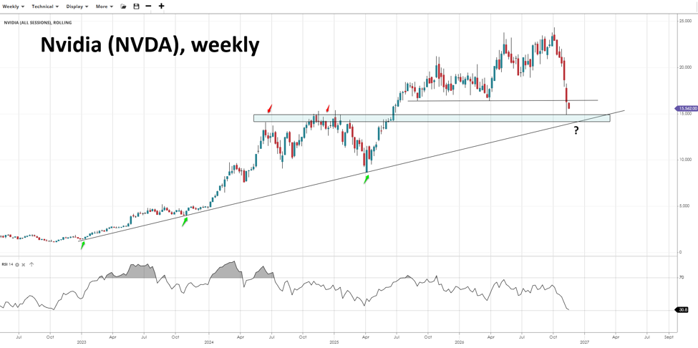
Source: SpreadEx | Nvidia, Weekly Chart
It's easy to open an account
- Fill in our simple online application form
- Fund your account
- Start trading the global markets instantly!
SEARCH FOR AN ARTICLE:
Enter a keyword and search for all relevant articlesMARKET ANALYSIS
RECENT POSTS
DISCLAIMER
Spread bets and CFDs are complex instruments and come with a high risk of losing money rapidly due to leverage. 64% of retail investors lose money when trading spread bets and CFDs with this provider. You should consider whether you understand how spread bets and CFDs work and whether you can afford to take the high risk of losing your money. For professional clients, spread betting and CFD trading can also result in losses larger than your initial stake or deposit.
Spreadex Ltd is authorised and regulated by the Financial Conduct Authority, provides an execution only service and does not provide advice in any way. Nothing within this update should be deemed to constitute the provision of investment advice, recommendations, any other professional advice in any way, or a record of our trading prices. This update does not constitute or form part of an offer of, or solicitation for a transaction in any financial instrument, nor shall it or the fact of its distribution form the basis of, or be relied on in connection with, any contract therefore. Any persons placing trades based on their interpretation of the comments or information within this update does so entirely at their own risk.
No representation, warranty, or undertaking, express or limited, is given as to the accuracy or completeness of the information or opinions contained within this update by Spreadex Ltd or any of its employees and no liability is accepted by such persons for the accuracy or completeness of any such information or opinions. As such, no reliance may be placed for any purpose on the information and opinions contained within this update.
The information contained within this update is the intellectual property of Spreadex Ltd and is protected by UK and International copyright laws. All rights reserved. Users may however freely download, distribute and reproduce extracts of the contents, subject always to accrediting Spreadex Ltd as the source and providing a hyperlink to www.spreadex.com.


