Financial Trading Blog
Signs that the EUR/GBP Long Downtrend Could Be Over
EUR/GBP has bounced off a 20-month low, and for the first time in two months the euro bulls have something to work with.
The pair fell to 0.8320 on Wednesday, its lowest since late March 2025, before rallying 0.4% on Thursday in its biggest one-day gain in five months. Friday's stronger-than-expected UK retail sales took some of the shine off the move, but the backdrop for the pair looks less one-sided than it did in October.
Latest Market Moves
EUR/GBP rose as much as 0.5% on Thursday to 0.8384 and closed up 0.4% at 0.8379, then eased back to around 0.8370 in early Friday trade after the UK retail data.
GBP/USD was up about 0.1% near 1.3100 on Friday morning, not far from the one-month low it hit after Wednesday's UK inflation figures.
EUR/USD was flat around 1.0970 heading into Friday's European session, with the US Dollar Index holding near its highest level since April 2025.
UK 2-year gilt yield was around 4.91% on Friday morning, roughly 180 basis points above the German 2-year yield near 3.09%.
UK Retail Sales Beat, but Stockpiling Did the Heavy Lifting
UK shoppers spent more than expected in October, though the reasons are less encouraging than the headline suggests.
Retail sales volumes rose 0.7% on the month against forecasts of no change, and were 2.3% higher than a year earlier. September's fall was revised deeper, to 0.6%.
Much of the gain came from supermarkets selling more long-life food such as tinned goods and UHT milk, after the government launched its “Be Ready” emergency-preparedness campaign on 22 October. A one-off stock-up like that tends to reverse, so the pound's modest lift from the data may not last.
ECB vs BoE: The Rate Gap Behind the Slide
The biggest driver of EUR/GBP's slide since late September has been the gap between UK and eurozone interest rates.
The Bank of England raised Bank Rate by a quarter point to 4% on 5 November, its first hike since 2023, with Catherine Mann voting for a half-point move. Chief Economist Huw Pill has since said market expectations of Bank Rate rising to 5% in 2027 are “not outrageous”. The ECB, by contrast, held its deposit rate at 2.5% on 29 October after hiking in June and September.
That leaves UK 2-year yields well above their German equivalents, which rewards holding sterling over the euro. The odd part is that eurozone inflation is now running hotter, at 4.0% in October against 3.6% in the UK, which suggests the ECB has more catching up to do.
Why the Euro Has Struggled
Rates are only part of the story, as the euro has also been carrying a political risk premium.
French government bond yields climbed to their highest since 2002 in October, with the country's presidential election next spring hanging over its fiscal outlook. France's flash composite PMI also slipped into contraction at 48.4 in October, while the wider eurozone grew at a slower pace of 51.9.
Leadership uncertainty has added to the pressure, with Christine Lagarde announcing she will step down as ECB President on 7 February, well before her term ends in October 2027. There are early signs that some of this stress is fading, though, with the premium on French debt narrowing to around 150 basis points from a 15-year high near 180.
What Could Turn the Trend
The most likely catalyst is a narrowing of the rate gap, and the ECB looks ready to start closing it.
Bundesbank President Joachim Nagel said this month that “it is rather obvious that we have to increase in December”. On the UK side, core inflation held steady at 2.8% in October, leading investors to trim bets on a back-to-back BoE hike.
Both central banks announce their decisions on 17 December, and an ECB hike alongside a BoE pause would be the clearest signal yet that the downtrend is over. Before then, Monday's flash PMIs, eurozone inflation on 1 December and UK inflation on 16 December will shape expectations.
EUR/GBP Technical Analysis
The daily chart shows EUR/GBP pushing out of a three-week base after a steady slide from late September.
The pair fell from 0.8612 on 25 September to 0.8322 on 30 October, then spent most of November in a tight range between roughly 0.8320 and 0.8375. Wednesday's dip to 0.8320 tested the bottom of that range again, but Thursday's rally took the price above the upper band of the 20-day Donchian channel for the first time since the downtrend began.
The RSI tells a similar story. It spent most of October below 30, and the lows of 30 October and 18 November formed a bullish divergence, with price making a marginally lower low while the RSI made a much higher one. It has now recovered to around 50 for the first time since late September.
Initial resistance sits between 0.8384 and 0.8402, where Thursday's high meets the 23.6% Fibonacci retracement of the September to November decline at 0.8389 and the 26 October swing high. A daily close above that zone would strengthen the reversal case and open the way to the 38.2% level near 0.8431, while a drop back below the channel midpoint around 0.8350 would put the 0.8320 lows back in play.
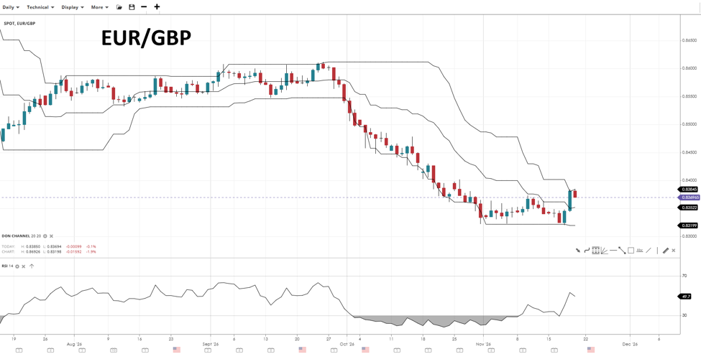
Source: SpreadEx | EUR/GBP, Daily Chart
It's easy to open an account
- Fill in our simple online application form
- Fund your account
- Start trading the global markets instantly!
SEARCH FOR AN ARTICLE:
Enter a keyword and search for all relevant articlesMARKET ANALYSIS
RECENT POSTS
DISCLAIMER
Spread bets and CFDs are complex instruments and come with a high risk of losing money rapidly due to leverage. 64% of retail investors lose money when trading spread bets and CFDs with this provider. You should consider whether you understand how spread bets and CFDs work and whether you can afford to take the high risk of losing your money. For professional clients, spread betting and CFD trading can also result in losses larger than your initial stake or deposit.
Spreadex Ltd is authorised and regulated by the Financial Conduct Authority, provides an execution only service and does not provide advice in any way. Nothing within this update should be deemed to constitute the provision of investment advice, recommendations, any other professional advice in any way, or a record of our trading prices. This update does not constitute or form part of an offer of, or solicitation for a transaction in any financial instrument, nor shall it or the fact of its distribution form the basis of, or be relied on in connection with, any contract therefore. Any persons placing trades based on their interpretation of the comments or information within this update does so entirely at their own risk.
No representation, warranty, or undertaking, express or limited, is given as to the accuracy or completeness of the information or opinions contained within this update by Spreadex Ltd or any of its employees and no liability is accepted by such persons for the accuracy or completeness of any such information or opinions. As such, no reliance may be placed for any purpose on the information and opinions contained within this update.
The information contained within this update is the intellectual property of Spreadex Ltd and is protected by UK and International copyright laws. All rights reserved. Users may however freely download, distribute and reproduce extracts of the contents, subject always to accrediting Spreadex Ltd as the source and providing a hyperlink to www.spreadex.com.


