Financial Trading Blog
What a Rumoured US Diesel Export Ban Means for Oil
Oil traders are weighing up a policy that would turn the usual logic of an energy shock on its head.
President Trump has floated banning US diesel exports to tame record pump prices, with a 90-day ban reportedly under discussion despite a White House denial. A ban could potentially weigh on WTI while supporting Brent, although a deal to reopen the Strait of Hormuz could make the whole debate redundant.
Latest Market Moves
WTI had eased back toward $93 a barrel in early Friday trade after a 2.7% jump on Thursday, leaving it on course for a weekly loss of around 2%.
Brent slipped about 1% to near $105 heading into the European session, keeping its premium over WTI at roughly $12 a barrel.
US Dollar Index held near 101.2, up about 1% on the week and close to its highest level since late July.
US retail diesel averaged around $6.51 a gallon midweek, a record high and up roughly 76% from a year ago.
Why Diesel Is in the Crosshairs
Diesel, not unrefined crude, is where the supply squeeze is being felt hardest by consumers.
Damage to Middle East refineries from the Iran war and Ukrainian drone strikes on Russian refining capacity have tightened global fuel supply, and US refiners have filled the gap, with diesel exports hitting a record 1.6 million barrels per day in August. That has left US distillate stocks almost 12% below their five-year seasonal average, even with refineries running at around 97% of capacity.
Trump backed the idea of a ban on the sidelines of the UN this week, saying "I've called for it. I've called for it within my people." Politico then reported that a 90-day ban was being prepared, which the White House denied, while Energy Secretary Chris Wright said the focus was on "the most efficient way to get more diesel into the United States of America".
With the midterms less than seven weeks away and farm-state Republicans pushing for action, the idea is unlikely to go away quietly.
Bearish for WTI, Bullish for Brent
A ban would likely hit US crude prices harder than global ones.
Blocking exports would initially flood the domestic market with diesel, but once storage fills refiners would be forced to cut runs, a risk Wright has reportedly flagged to the White House. Fewer refinery runs means less demand for US crude, at a time when US crude stocks already sit about 2% above their five-year average.
The rest of the world would lose a supplier of roughly a fifth of global diesel exports, with Latin America and Europe most exposed. That would likely push international fuel prices and Brent higher, widening a Brent-WTI spread that is already above $12 a barrel.
Inflation and Rate Hike Risks
The inflation maths of a ban is less clear-cut than it looks.
Diesel moves freight, farm equipment and construction, so cheaper diesel at home would ease one of the stickiest cost pressures in the economy, at least at first. But if refiners cut runs, gasoline and jet fuel supply would shrink too, which could push those prices higher and offset much of the benefit.
A Hormuz Deal Makes a Ban Unnecessary
The diesel ban story is being treated with a pinch of sale for now since there is still lingering hopes of diplomacy between Tehran and Washington.
Reports on Thursday said US and Iranian negotiators, with Qatar mediating, are exploring a phased deal that would see Iran reopen the Strait of Hormuz in exchange for the US lifting its blockade of Iranian ports. Iran's President Masoud Pezeshkian has said Tehran won't let ships pass freely while sanctions and the blockade remain, and Secretary of State Marco Rubio said this week that Revolutionary Guard leaders were impeding talks.
If a deal does land, restored Gulf crude and fuel flows would ease the diesel crunch directly and remove much of the case for a ban.
WTI Holds the Line Above Key Support
WTI's pullback from its mid-September highs still looks like a correction within a larger uptrend.
Prices spent the middle of the month locked in a tug of war around the $100 mark, peaking near $102.60 before sliding back inside a falling channel. The drop found support around $88.40, the 61.8% Fibonacci retracement of the late-August to mid-September rally, and has since rebounded to trade between the 50% and 38.2% levels.
Price is also holding above the 150-period SMA, now rising through the mid-$80s, which keeps the longer-term trend pointing higher. A break above the channel top would put $100 back in focus, while a close below $88.40 would open the door to the SMA around $86.60.
The 14-period RSI has recovered to around 48, having never reached oversold, characteristic of an uptrend.
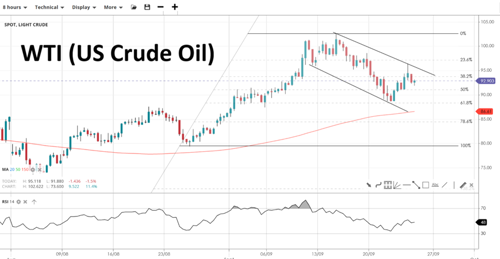
Source: SpreadEx | SPOT, Light Crude, 8-Hour Chart
It's easy to open an account
- Fill in our simple online application form
- Fund your account
- Start trading the global markets instantly!
SEARCH FOR AN ARTICLE:
Enter a keyword and search for all relevant articlesMARKET ANALYSIS
RECENT POSTS
DISCLAIMER
Spread bets and CFDs are complex instruments and come with a high risk of losing money rapidly due to leverage. 61% of retail investors lose money when trading spread bets and CFDs with this provider. You should consider whether you understand how spread bets and CFDs work and whether you can afford to take the high risk of losing your money. For professional clients, spread betting and CFD trading can also result in losses larger than your initial stake or deposit.
Spreadex Ltd is authorised and regulated by the Financial Conduct Authority, provides an execution only service and does not provide advice in any way. Nothing within this update should be deemed to constitute the provision of investment advice, recommendations, any other professional advice in any way, or a record of our trading prices. This update does not constitute or form part of an offer of, or solicitation for a transaction in any financial instrument, nor shall it or the fact of its distribution form the basis of, or be relied on in connection with, any contract therefore. Any persons placing trades based on their interpretation of the comments or information within this update does so entirely at their own risk.
No representation, warranty, or undertaking, express or limited, is given as to the accuracy or completeness of the information or opinions contained within this update by Spreadex Ltd or any of its employees and no liability is accepted by such persons for the accuracy or completeness of any such information or opinions. As such, no reliance may be placed for any purpose on the information and opinions contained within this update.
The information contained within this update is the intellectual property of Spreadex Ltd and is protected by UK and International copyright laws. All rights reserved. Users may however freely download, distribute and reproduce extracts of the contents, subject always to accrediting Spreadex Ltd as the source and providing a hyperlink to www.spreadex.com.


