Financial Trading Blog
Crude Jumps as Trump Turns on Putin, But Can the Rally Last?
The price of crude jumped last week after the White House sanctioned two Russian oil companies and has since gained further support as the US and China appear close to a trade deal.
The Key Developments
- The US sanctioned two of Russia's largest crude exporters last week, sending crude prices soaring.
- The sanctions were followed by Trump cancelling an anticipated meeting with Putin in Hungary, the latest sign of souring relations between Moscow and Washington over the war in Ukraine.
- Crude prices got a further boost amid optimism that the US and China will achieve a trade deal that could be signed when their respective presidents meet on Thursday.
Geopolitics Support Crude Despite Fundamentals
Last Thursday, Brent jumped $5 to $66 per barrel, after US President Donald Trump imposed sanctions on two of Russia's largest oil producers. The upward momentum was sustained after Trump cancelled a prospective meeting with Russian President Vladimir Putin over the war in Ukraine. The US President said that he saw little progress in talks. Taken in conjunction, they are another sign that US policy is shifting against Russia as Moscow continues to prosecute the war in Ukraine and Trump pushes to keep his campaign promise to end it.
The sanctions on Rosneft and Lukoil by US authorities caused an immediate ripple effect in the oil market, with supertanker rates rising dramatically as buyers scrambled to replace Russian oil. Analysts suggest that the sanctions represent the largest US escalation against Russia's energy sector since the war began and that the relatively low oil price gives the White House room to take further steps to restrict Russian exports. Russia exports around 4.3 million barrels per day, down from the average of around 5.0 million in the 2020-2024 period. The benchmark US crude price, WTI, jumped 6% in response to the sanctions but is still 14% lower since the start of the year, giving Trump scope to hurt Russia's finances while still shielding US drivers.
China Optimism Boosts Prices
The pivot in US policy comes at a critical juncture in trade negotiations with China, the largest buyer of Russian crude. Late on Sunday, US Treasury Secretary Scott Bessent announced that he'd reached a "framework understanding" with his Chinese counterpart on a trade deal that would be submitted to the respective presidents to approve. Trump and Chinese President Xi Jinping are expected to meet on the sidelines of the APEC meeting on Thursday. The deal reportedly includes China resuming purchases of US soybeans and easing export controls on rare-earth metals. Trump expressed optimism early Monday on reaching an agreement as he flew with Bessent to Tokyo. The US has been pressuring China to reduce oil purchases from Russia. Additionally, easing trade tensions is seen as supporting global economic growth and increased crude consumption. The IEA had previously warned of a supply glut, partly due to trade tensions that lowered global oil demand.
Brent Rally at Risk amid Flattening VWAP
Brent prices have formed a bottom near the lower VWAP around the $60 per barrel handle, bouncing towards the upper band of $67 but meeting resistance at the descending auto-trendline connecting $81 to $69. With VWAP width relatively flat, Brent could decline back towards the $63 middle line in a pullback fashion, correct deeper near $62, or even fully reverse the recent rally given the width of the VWAP. On the other hand, a strong breakout above the trendline and the upper VWAP could open the door to $70, confirming the bullish bias shown in the RSI at the time the double bottom formed.
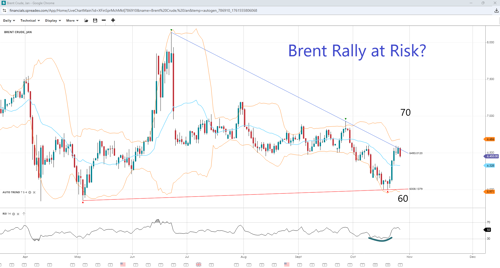
Source: SpreadEx | Brent Crude, Daily Chart
It's easy to open an account
- Fill in our simple online application form
- Fund your account
- Start trading the global markets instantly!
SEARCH FOR AN ARTICLE:
Enter a keyword and search for all relevant articlesMARKET ANALYSIS
RECENT POSTS
DISCLAIMER
Spread bets and CFDs are complex instruments and come with a high risk of losing money rapidly due to leverage. 62% of retail investors lose money when trading spread bets and CFDs with this provider. You should consider whether you understand how spread bets and CFDs work and whether you can afford to take the high risk of losing your money. For professional clients, spread betting and CFD trading can also result in losses larger than your initial stake or deposit.
Spreadex Ltd is authorised and regulated by the Financial Conduct Authority, provides an execution only service and does not provide advice in any way. Nothing within this update should be deemed to constitute the provision of investment advice, recommendations, any other professional advice in any way, or a record of our trading prices. This update does not constitute or form part of an offer of, or solicitation for a transaction in any financial instrument, nor shall it or the fact of its distribution form the basis of, or be relied on in connection with, any contract therefore. Any persons placing trades based on their interpretation of the comments or information within this update does so entirely at their own risk.
No representation, warranty, or undertaking, express or limited, is given as to the accuracy or completeness of the information or opinions contained within this update by Spreadex Ltd or any of its employees and no liability is accepted by such persons for the accuracy or completeness of any such information or opinions. As such, no reliance may be placed for any purpose on the information and opinions contained within this update.
The information contained within this update is the intellectual property of Spreadex Ltd and is protected by UK and International copyright laws. All rights reserved. Users may however freely download, distribute and reproduce extracts of the contents, subject always to accrediting Spreadex Ltd as the source and providing a hyperlink to www.spreadex.com.


