Financial Trading Blog
Powell's Last FOMC Meeting
With a strong consensus that the Fed won't change rates on Wednesday, the focus is on what will change under a new administration and whether that will mean more dovishness amid inflationary pressures.
The Key Market-Moving Factors
- Markets are unanimous in expecting a hold at the Wednesday FOMC, with a focus on the outlook.
- Odds of a rate cut this year are around 40% ahead of the meeting as traders emphasise uncertainty around inflation due to higher energy prices.
- This is the last meeting to be presided over by Powell, with the focus shifting to changes Kevin Warsh might implement starting at the June meeting.
- Gold prices struggle to gain ground as investors worry that persistent inflation will keep the Fed from easing this year, despite the incoming dovish Chair.
When Will the Fed Cut Rates?
Economists and futures markets are 100% in lockstep, expecting the Fed to hold rates unchanged on Wednesday, the last meeting presided over by Jerome Powell. However, given the circumstances, several factors could trigger a significant reaction and prompt asset movement. A lot has changed since the last meeting, when the Fed also kept rates unchanged, mostly punting the decision until more data on the war in the Middle East becomes available.
Over the weekend, the DOJ dropped its probe into Fed Chair Jerome Powell's management of renovations in the building, clearing the path for Kevin Warsh to be approved by the Senate as the new Chair for the next meeting. But that doesn't end the controversy, as a former Fed chair typically doesn't remain in the governor's role. Powell has indicated he intends to stay on amid friction with the White House, but he could change his mind and disclose it during the post-rate-decision press conference. That would open another seat on the board, likely to be filled by a dovish Trump appointee, prompting the market to recalibrate its outlook.
If the last meeting was meant to buy time to get more clarity on the economic situation, it hasn't really worked, as considerable inflation and employment uncertainty remain. This has left markets in a bind, with gold prices generally near the $4,600 per ounce level as markets see only a 40% chance of a rate cut this year. While there have been indications that inflationary pressures have increased, the indefinite ceasefire in the Middle East leaves the Strait of Hormuz still closed, with no clear opening date. The Fed can't yet declare inflation temporary or structural, but that won't stop analysts from parsing the comments for clues.
Key Takeaways for Gold
There will be no new dot plot or economic summary for markets to parse, so the focus will be on commentary to gain insight into where FOMC officials think the economy is headed. The outcome could be pivotal for gold, which hasn't managed to break back towards January levels amid uncertainty about monetary policy. The main issue will be how concerned the Fed is about inflation, since analysts believe rates will trend downward unless war-driven consumer price increases keep them elevated. Powell's dovish or hawkish tone may be less relevant this time around, since it is his last meeting. Still, traders will likely pay close attention to the emphasis on inflation relative to economic growth in his commentary. Gold has struggled amid rising yields, but a more dovish tone from the Fed could give it a boost later this week.
Gold Hints at Range at Lower VWAP
The recent drop in gold prices has brought the yellow metal to the lower VWAP of $4630, with a flattening upper line at $4870 suggesting a potential consolidation. However, the tightening of the bands hints at a potential breakout if there is a squeeze in lower time frames, with a breakdown opening the door to $4500 and a reversal back above the midline of $4740 exposing the positive VWAP.
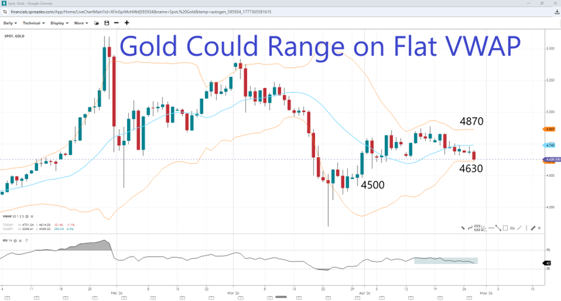
Source: SpreadEx | Gold, Daily Chart
It's easy to open an account
- Fill in our simple online application form
- Fund your account
- Start trading the global markets instantly!
SEARCH FOR AN ARTICLE:
Enter a keyword and search for all relevant articlesMARKET ANALYSIS
RECENT POSTS
DISCLAIMER
Spread bets and CFDs are complex instruments and come with a high risk of losing money rapidly due to leverage. 61% of retail investors lose money when trading spread bets and CFDs with this provider. You should consider whether you understand how spread bets and CFDs work and whether you can afford to take the high risk of losing your money. For professional clients, spread betting and CFD trading can also result in losses larger than your initial stake or deposit.
Spreadex Ltd is authorised and regulated by the Financial Conduct Authority, provides an execution only service and does not provide advice in any way. Nothing within this update should be deemed to constitute the provision of investment advice, recommendations, any other professional advice in any way, or a record of our trading prices. This update does not constitute or form part of an offer of, or solicitation for a transaction in any financial instrument, nor shall it or the fact of its distribution form the basis of, or be relied on in connection with, any contract therefore. Any persons placing trades based on their interpretation of the comments or information within this update does so entirely at their own risk.
No representation, warranty, or undertaking, express or limited, is given as to the accuracy or completeness of the information or opinions contained within this update by Spreadex Ltd or any of its employees and no liability is accepted by such persons for the accuracy or completeness of any such information or opinions. As such, no reliance may be placed for any purpose on the information and opinions contained within this update.
The information contained within this update is the intellectual property of Spreadex Ltd and is protected by UK and International copyright laws. All rights reserved. Users may however freely download, distribute and reproduce extracts of the contents, subject always to accrediting Spreadex Ltd as the source and providing a hyperlink to www.spreadex.com.


