Financial Trading Blog
Are Microsoft Shares in Trouble After 'Code Red' Outage?
Microsoft has declared a "Code Red" after a day-long Microsoft 365 outage, but the bigger test for the stock may be the cost of its AI build-out.
The shares barely reacted to the outage and have instead slipped with the wider AI sell-off. Microsoft was trading around $486 in early Wednesday pre-market dealing, roughly 13% below the record high set on 4 November, after a third failure in the $550-560 area since mid-2025.
Latest Market Moves
Microsoft rose 0.7% to close at $496.13 on Tuesday after trading between $488.43 and $501.82, but was down about 2% in pre-market trade on Wednesday.
The Nasdaq 100 fell 2.0% on Tuesday to close at 26,214, leaving it down around 9% over the past month as chip stocks gave back Monday's rally.
Alphabet and Amazon were both down around 3% pre-market on Wednesday after falling more than 1% on Tuesday.
Oracle dropped 3.7% on Tuesday and is down around 45% this year as the market punishes the heaviest AI spenders.
Apple gained 1.4% on Tuesday and is up around 30% year to date, compared with a gain of just over 2% for Microsoft.
A Day Without Email
The 12-13 November outage knocked out Exchange Online, Outlook, Teams and Copilot for around 24 hours, disrupting governments from Australia and Japan to the US, delaying trading firms and hampering airline communications.
Microsoft blamed a Windows software defect introduced in July, not a cyberattack, and has since declared a Code Red to overhaul how it handles major failures. An internal memo said engineers worked through a "fog of war", swapping more than 11,000 messages across 11 Teams chats, and the company is now targeting a one-hour fix for future incidents.
The stock shrugged it off, closing higher on 13 November after an early dip, and Satya Nadella's public apology barely registered either. It was the second major failure in about a year, after an eight-hour Azure outage in October 2025.
Where Else Would Customers Go?
The outage has revived the debate over concentration risk, but the practical alternatives are narrower than the anger suggests.
On the desktop there is no real enterprise substitute for Windows, and Microsoft 365 is so tightly bundled with email, identity and Teams that leaving means rebuilding a company's IT stack. Google Workspace is the obvious rival, and Google has offered outage back-up and migration tools to Microsoft users since 2025. But switching suites is a multi-year project rather than a reaction to one bad day.
Cloud is more contestable, with AWS and Google Cloud chasing the same AI workloads, though Microsoft's licensing still makes its software cheaper to run on Azure than on rival clouds. The more likely cost of the outage is pressure on pricing at contract renewals rather than a wave of defections.
Earnings Are Strong, Cash Flow Is the Worry
Microsoft's latest results gave little sign of customers walking away.
Revenue rose 19% to $92.3 billion in the quarter to 30 September, with Azure up 48% and diluted earnings per share up 32%. The catch is spending, with capital spending roughly doubling to $39.4 billion and free cash flow falling to $18.6 billion from $25.7 billion a year earlier.
Microsoft expects around $175 billion of reported capital spending in calendar 2026, a figure helped by an accounting change on data centre leases, and says it will stay free-cash-flow positive this fiscal year. But the margin for error is thinner than it used to be, and reports that it is preparing for a possible loss of access to OpenAI technology add to the uncertainty.
Does Microsoft Get a Safety Bid?
Not in the way Apple does.
Apple is up around 30% this year while Microsoft is up just over 2%, broadly in line with the Nasdaq 100, as investors favour big tech names with lighter AI spending. Within the hyperscaler group, though, Microsoft has held up better, down around 4% over the past month against falls of 12-13% for Alphabet and Oracle.
Microsoft Technical Analysis
Microsoft has now been turned back three times in the $550-560 zone, but its long-term uptrend is intact.
Three tops there since mid-2025 form a potential triple top, and the weekly RSI peaked lower this time, a bearish divergence that points to fading momentum. A sustained break above $560 would be needed to clear the ceiling.
The key support is around $470, the 2024 high that acted as a floor in late 2025 and was reclaimed on the July results gap. A weekly close below there would put the triple top in play, though the long-term uptrend line from the 2020 low only comes in around $365.
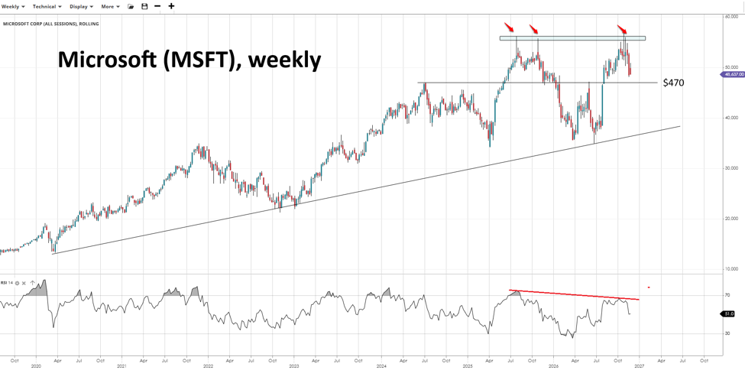
Source: SpreadEx | Microsoft, Weekly Chart
It's easy to open an account
- Fill in our simple online application form
- Fund your account
- Start trading the global markets instantly!
SEARCH FOR AN ARTICLE:
Enter a keyword and search for all relevant articlesMARKET ANALYSIS
RECENT POSTS
DISCLAIMER
Spread bets and CFDs are complex instruments and come with a high risk of losing money rapidly due to leverage. 64% of retail investors lose money when trading spread bets and CFDs with this provider. You should consider whether you understand how spread bets and CFDs work and whether you can afford to take the high risk of losing your money. For professional clients, spread betting and CFD trading can also result in losses larger than your initial stake or deposit.
Spreadex Ltd is authorised and regulated by the Financial Conduct Authority, provides an execution only service and does not provide advice in any way. Nothing within this update should be deemed to constitute the provision of investment advice, recommendations, any other professional advice in any way, or a record of our trading prices. This update does not constitute or form part of an offer of, or solicitation for a transaction in any financial instrument, nor shall it or the fact of its distribution form the basis of, or be relied on in connection with, any contract therefore. Any persons placing trades based on their interpretation of the comments or information within this update does so entirely at their own risk.
No representation, warranty, or undertaking, express or limited, is given as to the accuracy or completeness of the information or opinions contained within this update by Spreadex Ltd or any of its employees and no liability is accepted by such persons for the accuracy or completeness of any such information or opinions. As such, no reliance may be placed for any purpose on the information and opinions contained within this update.
The information contained within this update is the intellectual property of Spreadex Ltd and is protected by UK and International copyright laws. All rights reserved. Users may however freely download, distribute and reproduce extracts of the contents, subject always to accrediting Spreadex Ltd as the source and providing a hyperlink to www.spreadex.com.


