Financial Trading Blog
Markets Volatile After Historic Fed Intervention
US stocks were unusually volatile on Friday, with the S&P 500 falling by more than 1% in less than an hour amid reports of the Fed intervening to support the yen. Though markets recovered by the end of the session, it's important to know how the dip happened.
The Market-Moving Factors
- The USDJPY crashed over 500 pips on Friday, then the Fed and BOJ confirmed they had intervened in the currency.
- Fed intervention signals an escalation in efforts to contain the yen's slide, and confirmation is likely to be a message to markets.
- Stocks were volatile, initially falling after the intervention, as the yen is an important source of borrowing to support investment.
- The broader market ultimately recovered as investor focus remained on tech earnings.
Markets Fall, Recover After Fed's Historic Intervention
The start of Friday's trading session was volatile, with major US indices first rising, then dropping precipitously before struggling back to end higher. Market headlines focused on the closing bell championed a fourth straight month of gains for the DJIA, while the Nasdaq was lower for the month, indicating the growing momentum behind the rotation out of tech. What initially spooked the markets was first a rumour and later confirmation that the Fed had intervened in the market in coordination with the BOJ to prop up the yen. Why this is particularly relevant to US stocks – and equities globally – is that the BOJ has the lowest interest rates of any major economy. This makes it an ideal location for major investors to borrow money from in order to invest in stocks in other markets, the underlying current behind the carry trade that is chronically weakening the yen. Japanese officials have repeatedly warned about the rapid depreciation of their currency, attempting to curtail carry trading.
In a rare move, likely intended as a signal to markets, Japanese and US officials confirmed on Friday that they had intervened in the market. This was the first time in 15 years that the Fed and the BOJ had coordinated to affect the exchange rate, and it was in the aftermath of the 2011 earthquake. The Fed's participation is seen both as an escalation and also potentially a sign that the BOJ is reaching the limits of its ability to control its currency. Fed intervention is the final weapon that policymakers have to stabilise the yen. While Japan's Ministry of Finance can influence the exchange rate, it has limited dollars to sell to prop up the currency. The Fed has, in theory, unlimited dollars at its disposal. Interestingly, the Fed did not use its biggest tool, but instead, it sold euros to buy yen. This props up the yen and ropes the ECB into supporting the currency as well, while still preserving the Fed's main weapon to deal with unruly markets: selling its own currency.
The Yen Outlook and Market Implications
Following the market move, both US and Japanese officials confirmed that they are willing to intervene again if necessary. The USDJPY rose to above 163 before the intervention, then fell to just under 155. Prior intervention happened at the 162 level, indicating that policymakers are slowly raising the ceiling for intervention. In early trading on Monday, USDJPY has traded lower, falling below 155 briefly before quickly rejecting the round support. The question now is whether traders accept the combined Fed-BOJ threat and keep the pair below the new ceiling or try to challenge it once again. However, to prevent the pair from rising too fast, traders would have to curtail some carry trades, which would mean less liquidity in the stock market. So far, the market seems more focused on recent tech earnings and upcoming economic data, so it is still rising. However, the yen situation could be another source of nervousness for global equities, which could face upward resistance if USDJPY rises back toward the 164 handle.
USDPY Bounce Hints at Potential Bounce to Shoulder Peak
After losing 160.13 and the 160.00 psychological hurdle, USDJPY’s retest off 155 aligns with early May's recoil, which was followed by the ascent to 163.40. Despite resembling a double-bottom formation, the fact that the neckline sits at 160.13 and that there is a higher peak suggests a potential head-and-shoulders pattern. So any upside attempt above 157.50 (today’s peak) and 160 could meet resistance at the left shoulder’s height. However, if the pair fails to hold support, it would open the door to 152.50, paving the way for 150.
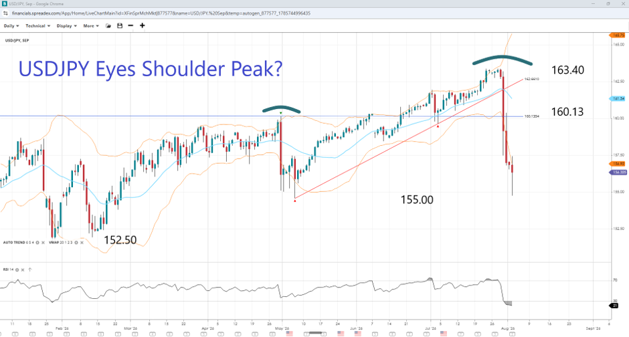
Source: SpreadEx | USDPY, Daily Chart
It's easy to open an account
- Fill in our simple online application form
- Fund your account
- Start trading the global markets instantly!
SEARCH FOR AN ARTICLE:
Enter a keyword and search for all relevant articlesMARKET ANALYSIS
RECENT POSTS
DISCLAIMER
Spread bets and CFDs are complex instruments and come with a high risk of losing money rapidly due to leverage. 61% of retail investors lose money when trading spread bets and CFDs with this provider. You should consider whether you understand how spread bets and CFDs work and whether you can afford to take the high risk of losing your money. For professional clients, spread betting and CFD trading can also result in losses larger than your initial stake or deposit.
Spreadex Ltd is authorised and regulated by the Financial Conduct Authority, provides an execution only service and does not provide advice in any way. Nothing within this update should be deemed to constitute the provision of investment advice, recommendations, any other professional advice in any way, or a record of our trading prices. This update does not constitute or form part of an offer of, or solicitation for a transaction in any financial instrument, nor shall it or the fact of its distribution form the basis of, or be relied on in connection with, any contract therefore. Any persons placing trades based on their interpretation of the comments or information within this update does so entirely at their own risk.
No representation, warranty, or undertaking, express or limited, is given as to the accuracy or completeness of the information or opinions contained within this update by Spreadex Ltd or any of its employees and no liability is accepted by such persons for the accuracy or completeness of any such information or opinions. As such, no reliance may be placed for any purpose on the information and opinions contained within this update.
The information contained within this update is the intellectual property of Spreadex Ltd and is protected by UK and International copyright laws. All rights reserved. Users may however freely download, distribute and reproduce extracts of the contents, subject always to accrediting Spreadex Ltd as the source and providing a hyperlink to www.spreadex.com.


